

Home & Decor Blogs: DIY, Interior Design & Lifestyle Ideas
How to Pick Window Treatments That Actually Work for Your Room — Not Just Look Good in the Photo


Most curtains are picked wrong before they ever go up, and it is nearly always the same slip. People fall for a colour and a fabric first and only get round to asking whether it suits the window once the thing is already hanging there. Looked great on the swatch, went lovely with the cushions, and now it is up and doing none of what you actually needed. Room is still hot by mid-afternoon. The lining came out thin enough that the neighbours get a show once the lights are on. Or six months go by and the colour starts going patchy in stripes because nobody warned you it was a west-facing window taking four hours of hard sun a day.
So do it backwards to how most people do. Sort out what the window actually has to do first, kill light, give privacy, hold heat in, or just frame the view, and then go find a fabric that does that. Half the time you walk out with something completely different to what you went in wanting, and that is usually the sign you got it right.
Why the Direction Your Window Faces Changes What Fabric You Need
This one thing decides whether your Window Treatments last two years or ten, and almost nobody thinks about it before they buy.
Every house has its hot windows and its quiet ones. Which is which depends on your hemisphere. Up north the south-facing windows cop the most sun because that is where the sun tracks all day. Down south it flips and the north-facing ones take the beating. Either way the rule does not change, the windows getting hammered with light need UV-resistant fabric, and the ones in shade can take pretty much anything you like.
A hot window is pulling six to eight hours of direct sun a day in summer, more the further you are from the poles. Under that, silk goes first. It turns brittle and the colour bleaches out unevenly, and you are looking at twelve to eighteen months before it is done, and once silk starts breaking down there is no saving it, you just replace it. Linen holds on a bit longer but it still fades, two to four years, and the lighter colours start losing their pigment the moment you start paying attention to it.
The fabrics that actually take the sun are polyester blends, solution-dyed acrylic, and heavy cotton duck. Solution-dyed is the one worth knowing about, it means the colour goes into the fibre when it is made, not painted onto the surface after, and that is the whole reason outdoor awning fabric stays bright for years while your indoor curtains go pale. That same trick is in indoor fabrics now, you just have to ask for it by name, because half the shops will not tell you the difference between surface-dyed and solution-dyed unless you bring it up first.
Your shaded windows, the ones the sun never really gets to, barely see any direct light, so honestly anything goes. Linen, cotton, silk, a sheer, whatever you like the look of. Nothing is going to UV-degrade over there, so you are just choosing on looks and weight.
West-facing windows are the sneaky ones. They catch low, hard sun late in the day, and in summer that lands right when it is already hottest. Put a sheer on a west-facing bedroom and you have got a room that has been baking since three in the afternoon. On those, blockout lining is not really a style choice, you need it.
Mounting Height Will Make Your Curtains Look More Expensive Than the Fabric
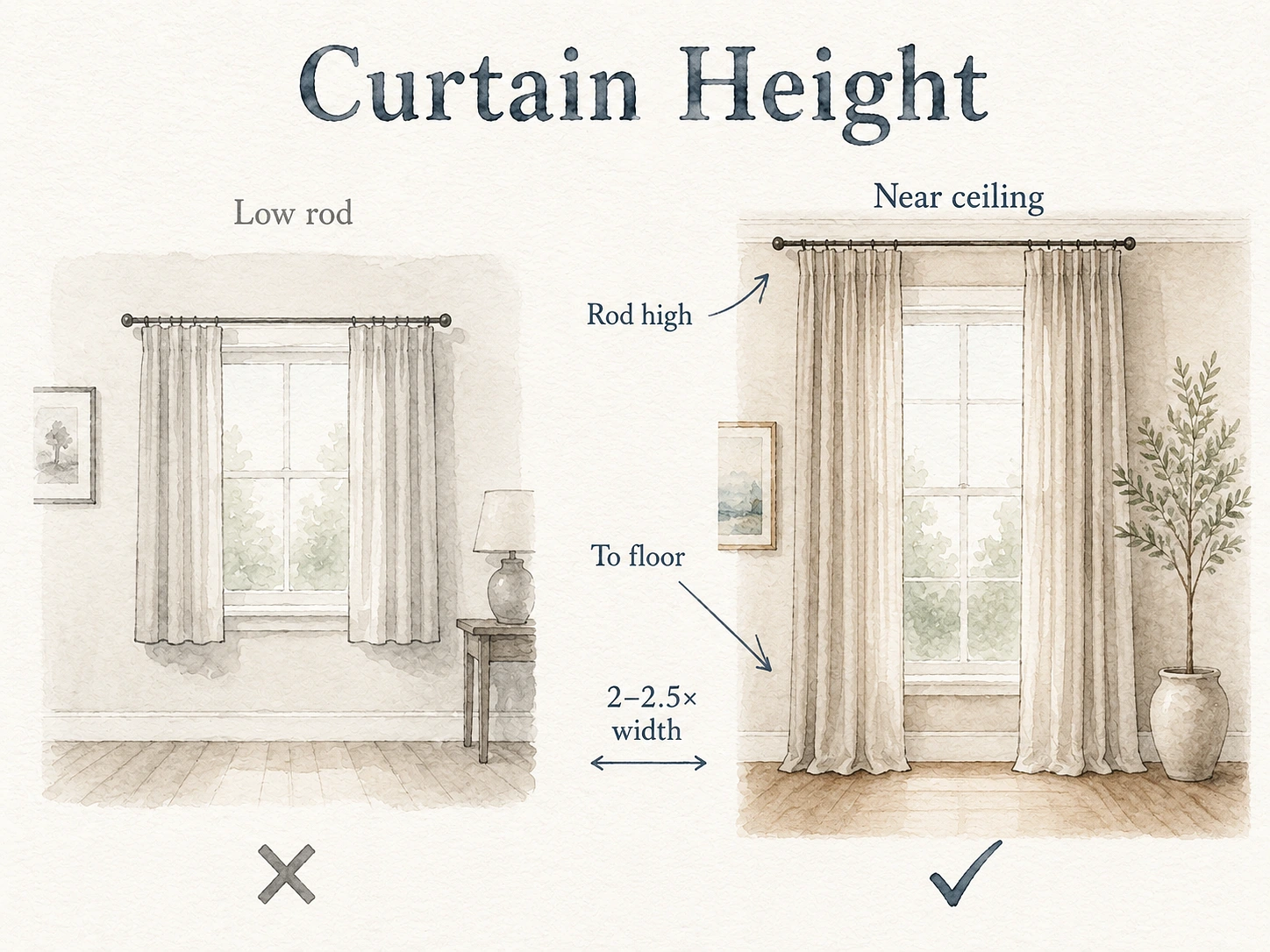
You can drop $800 on a gorgeous linen curtain and have it look cheap, or spend $200 on a plain one and have it look custom. The difference is almost never the fabric, it is where the rod sits and how long the curtain is.
The biggest single thing you can do is hang the rod up near the ceiling instead of right on top of the window frame. Most people stick it five or ten centimetres above the frame and leave it there. Take it up to the ceiling, or even just 30cm above the frame, and suddenly the window looks taller, the ceiling looks higher, and the whole thing reads like you meant it rather than an afterthought.
Then the curtain wants to drop all the way to the floor. Not hovering two inches up, not pooling in a heap at the bottom, just touching down the way a trouser hem breaks on a shoe. That is the whole tell between “looks like a display home” and “looks like a rental,” rod at the ceiling, fabric to the floor, and that is it.
Width matters just as much, maybe more. A panel that is only as wide as the window hangs flat and looks skimpy even shut. What you want is two to two and a half times the window width in total fabric, so a 150cm window wants 300 to 375cm of curtain across both panels. This is where you spot a cheap job first, budget curtains come thin and narrow because the fabric is the expensive bit, so they never quite close and they never fall into proper folds.
And if money is tight, cut the fabric quality before you cut the width. A full, well-gathered cheap curtain beats a flat, skimpy expensive one every single time.
What “Blockout” and “Room Darkening” Actually Mean — They Are Not the Same Thing
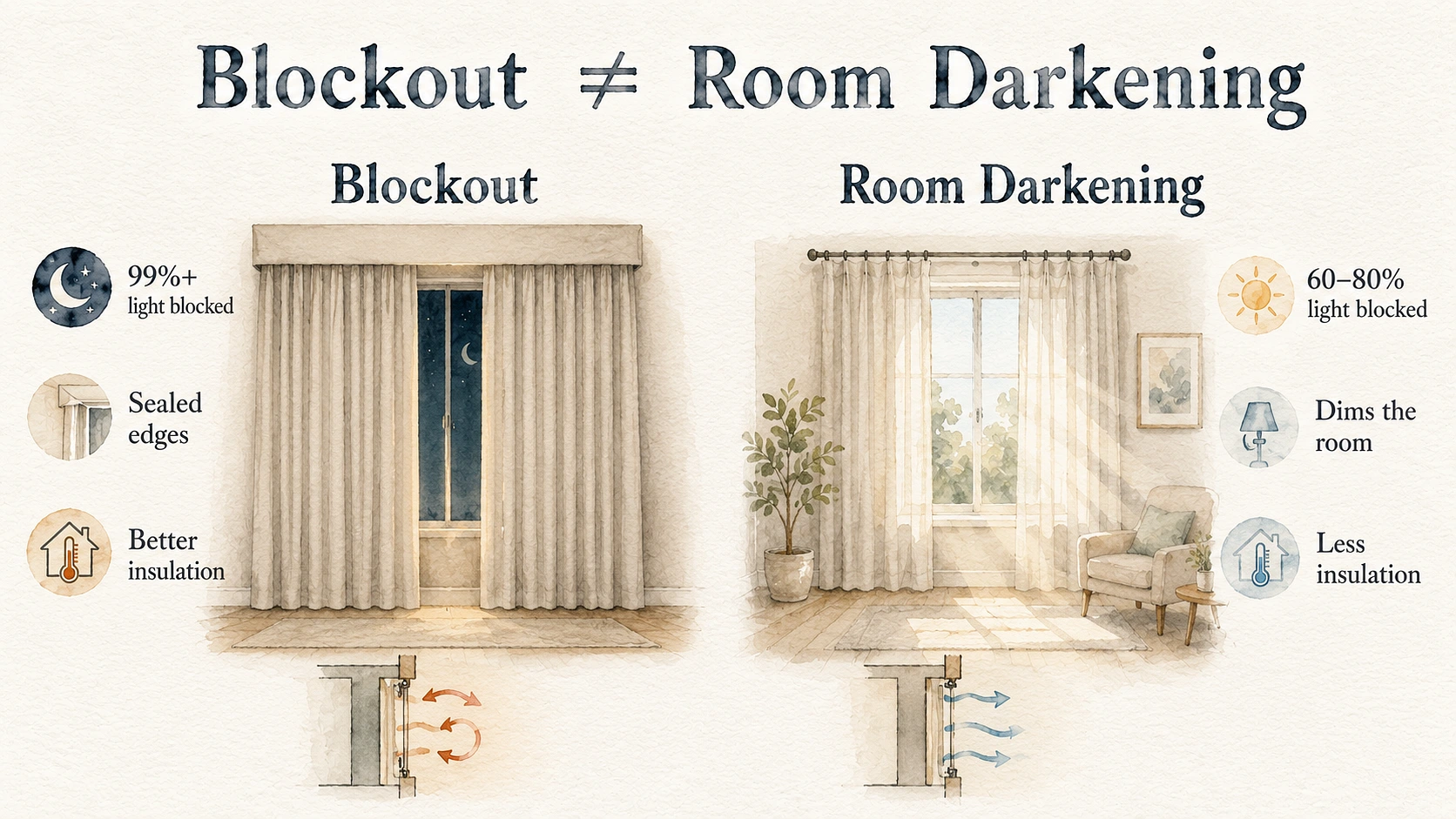
Shops throw these two words around like they are the same. They are not.
Blockout, or blackout, is a curtain with an opaque layer behind the nice fabric, usually foam-backed or a triple-weave bonded to the back. Fitted right it kills 99% of the light or more. Fitted right is the catch though, the curtain has to run 15cm past the frame on both sides and sit inside a pelmet or a return bracket up top so light cannot sneak around the edges. Get a real blockout curtain but leave those edges open and you end up with a glowing rectangle outlining the window, which is honestly worse than a semi-sheer, because now the light leak is the first thing your eye goes to instead of the dark room you were after.
Room darkening is the looser term. Usually it is a denser cloth or a single lining that stops maybe 60 to 80 percent of the light. Enough to take the edge off a room, not enough to make it properly dark for sleep. Fine in a living room. But if you sleep light, or you work shifts and need the room black at noon, it will not cut it in a bedroom.
There is a heat side to this too. A decent blockout with foam backing actually insulates a bit, it traps a pocket of dead air between the glass and the room, and in winter that gap noticeably slows the heat bleeding out through the window. Some independent tests have clocked blockout curtains cutting up to 25% of the heat loss from single-glazed windows, though how much you get really comes down to how well the thing seals at the edges. Skip the foam or triple-weave backing and it does basically nothing for insulation.
The Sheer Curtain Mistake Almost Everyone Makes
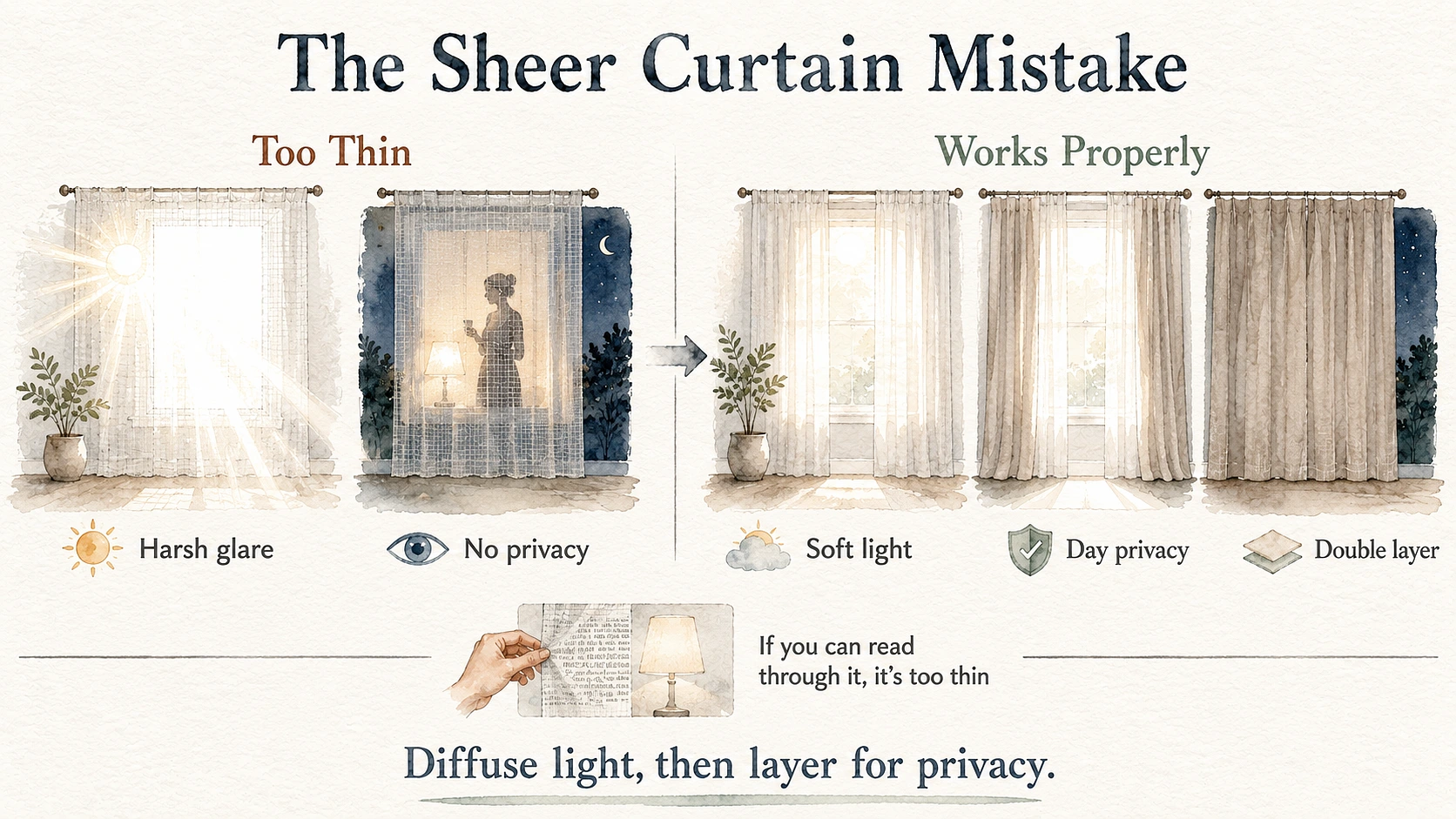
A sheer is meant to spread the light out and soften the window without killing the view. But the wrong sheer in the wrong room does the opposite, turns the window into a white glowing rectangle in the daytime and still lets the neighbours watch your shape move around at night.
It comes down to how dense the fabric is. The really cheap sheers are basically mesh. They let light straight through without softening any of it, so instead of a soft glow you get hard sun cutting through a barely-there fabric that also does nothing for privacy the second your lights come on after dark.
A proper sheer, the kind that scatters light instead of just letting it pass, has some body to it. Linen sheers do this on their own because the fibres are irregular and break the light up as it comes through. Synthetic voile looks flatter but does the job fine. Easy way to test it in the shop, hold the fabric up in front of a light. If you can read print through it, it is not going to diffuse anything at home either.
Layering a sheer under a heavier outer curtain is the setup that does everything, sheer on its own through the day with the heavy one pulled back, both shut at night for privacy and dark. Only catch is the layering falls apart if your rod or track cannot carry two layers. Bare minimum you need a double rod, one close to the window for the sheer and one further into the room for the heavy curtain. A ceiling-mounted double track looks cleaner, but it has to go in before you paint the ceiling, otherwise you are patching holes later.
Fabric Lifespan: What Lasts and What You Will Be Replacing in Two Years
How long a curtain lasts swings around a lot, and it nearly all comes down to two things, how much sun it takes and what the fibre is.
- Polyester and polyester blends. These go the longest and fade the least in direct sun, five to eight years on a south or west window. The trade-off is how it feels, polyester is not as soft as the natural stuff, and in the lighter weights it can look a bit plasticky.
- Cotton and cotton blends. Three to five years in moderate light. It fades slow enough that it almost looks intentional, and cotton goes soft as it ages, which some people actually like. Watch it in humid spots though, cotton will mildew if the window gets condensation.
- Linen. Lovely texture, but it is needy in the sun, two to four years before it starts fading badly on a sun-hit window. The other thing with linen is once it creases it stays creased, so tie it back and the crease lines at the tie point are there for good.
- Silk. Twelve to eighteen months in direct sun and you will see it going, colour washing out, fibres turning brittle and splitting. Keep silk on a shaded window, or tuck it behind a sheer that takes the UV for it. Anywhere else you are just burning money.
- Solution-dyed acrylic. Barely fades even in harsh sun, five to ten years. Built for outdoor marine and awning use originally. Most people have no idea there are softer indoor versions now in way more colours. If you have got a problem window, this is the one to think hard about.
Treat those as rough ranges, not promises, and they shift again depending on whether you have got UV film on the glass behind the fabric, which buys you a couple of extra years at least.
Hardware: The Part People Buy Last and Should Buy First
Rods and tracks usually get bought dead last in a home improvement job, and they are the bit that causes the most grief. A rod that cannot hold the weight bows in the middle. A flimsy track makes the curtains rattle every time you open them. And when the ring clips are cheap and snag instead of gliding, you stop pulling the curtains all the way open because it is annoying, so they end up stuck half open, which is the one thing curtains are not supposed to do.
Match the rod to the weight. A heavy curtain needs a heavy rod, so go solid timber or steel, not a hollow aluminium tube. The rods stacked up at the big box stores are made for light fabric, fine for sheers and light cotton, but they will sag under anything past about three kilograms a panel.
Right now everyone is buying matte black and brushed brass, that has been the look for a few years. Antique bronze is creeping back in warmer rooms. Chrome has fallen off, indoors it reads like early-2000s bathroom fittings now. But honestly the finish barely matters next to whether the thing is built solid. A matte black rod that sags under the weight looks worse than a plain white one that holds dead straight.
Buy the hardware before you order the curtains. Measure off the rod, not the window frame. Your drop depends on how high above the frame you end up mounting the rod, and getting curtains taken up after the fact costs you more than just putting the rod up first and measuring the drop from there.
 Decor & Improvement Accessories