

Home & Decor Blogs: DIY, Interior Design & Lifestyle Ideas
Signs Your Air Conditioner Is Costing More Than It Should (and How to Do the Math)

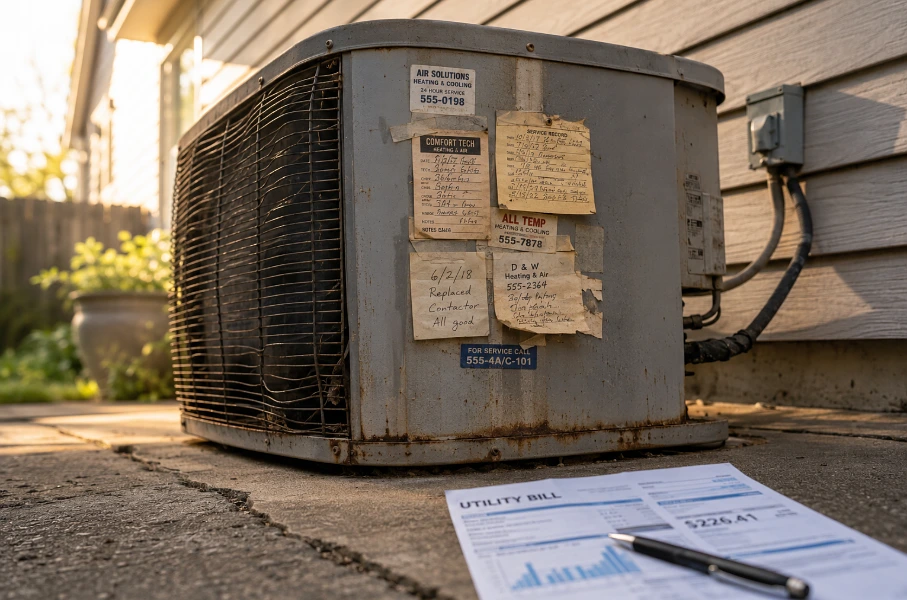
My AC is humming, my meter is spinning,
the house is still sweating and the power company is grinning,
and I am the one paying for both of them to keep winning.
That is the whole thing with an old air conditioner, it is charging you on 3 separate lines at once, the electric bill, the repair invoices, and the refrigerant, and each of those lines has its own warning signs and its own math. Read all 3 together and you are going to know whether you are repairing this thing or replacing it, without anyone having to sell you either one.
| Your situation | What the math is saying |
|---|---|
| Under 10 years old, first real repair | Repair it. |
| Age times repair quote passes $5,000 | Replace it, the repairs are now costing more than the machine. |
| Any repair above half the cost of a new system | Replace it. |
| R22 system with a leak | Replace it, every recharge is $660 or more and the leak is staying. |
| Past 15 years with rising bills | Replace it on your own schedule, before it quits in July. |
The 1 thing an old system is still giving you is time to choose, and it is giving you that right up to the afternoon it stops.
Why Your Electric Bill Keeps Climbing
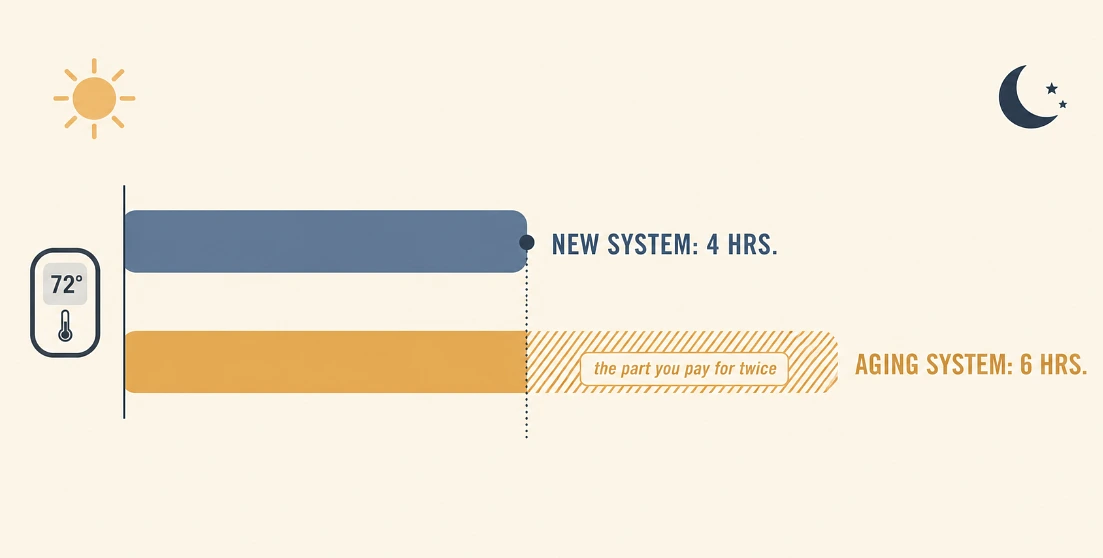
Longer run times are the first thing that changes, and they are changing well before a single extra dollar is showing up on the bill. The air at the vents is getting weaker as the coils and the blower foul up, and the house is feeling clammy even while it is cooling. Cold and damp at the same time, and why is that? Because a coil that is losing capacity is still chilling the air a little but it is too weak now to condense the moisture out of it, so the water is staying in the room with you. A wet basement with the lights on. And the bill is creeping up with no change at all in how you are living.
The waste is bigger than it feels from inside the house. Units from the early 2000s were commonly carrying SEER ratings of 8 to 10, the minimum equipment being sold today is sitting around 14 to 15, and swapping the one for the other is cutting cooling energy by 20 to 40 percent, which on normal usage is working out to somewhere around $200 to $500 a year. Every year. Nothing on the unit is telling you any of this, it is simply running 6 hours to get through 4 hours of work, and you are paying for all 6, and that has been going on for a few summers now.
How Many Repairs Is Too Many
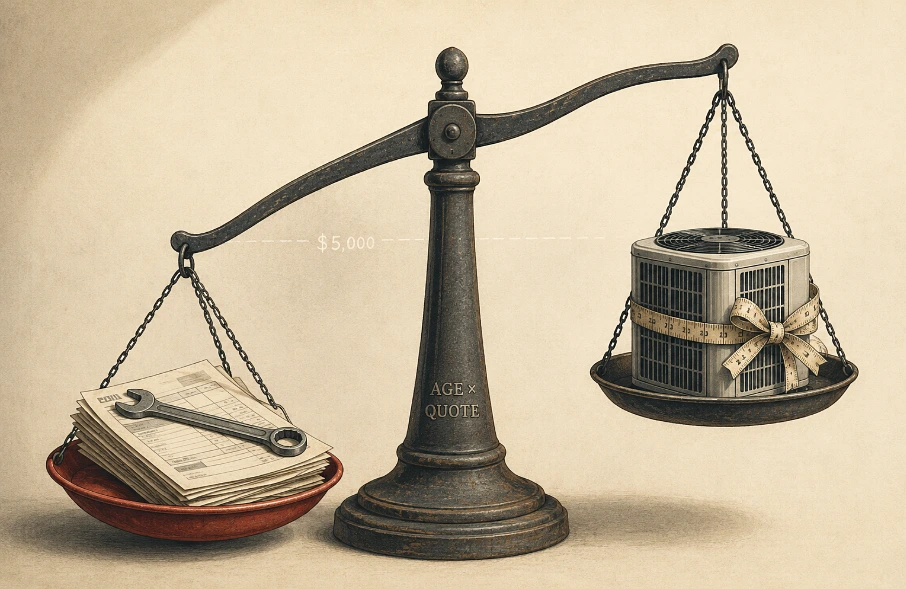
One repair a year is maintenance, 1 repair every season is a payment plan, and the line between them is sitting at a number. Every HVAC site on the internet is carrying the same rule, multiply the age of the system by the repair quote, and if the answer is passing $5,000 the money should be going toward a replacement instead. I went looking for who came up with it and could not find anyone. No name, no study, it is a rule of thumb someone typed once and everyone has been copying since, so the only way to trust it is to run it.
A $600 repair on a 7 year old unit is scoring 4,200, and that is a repair worth doing without a second thought.
The same $600 repair on a 12 year old unit is scoring 7,200, and sitting with that number the rule starts making sense, because a 12 year old compressor has maybe 3 summers left in it and $600 is going into a part on a machine that has been telling you for a while how this is going to end. So the rule holds, and not because the internet is saying so, it holds because the arithmetic is coming out the same way every time it is run.
The line is $5,000, and past it the repair money is going backwards. There is a second check as well, a simpler one, any single repair that is costing more than half the price of a new system is losing you money on the day it is done. A system past 15 years is failing both of those with almost any repair big enough to need a part ordered in.
What The Sticker On The Outdoor Unit Is Telling You
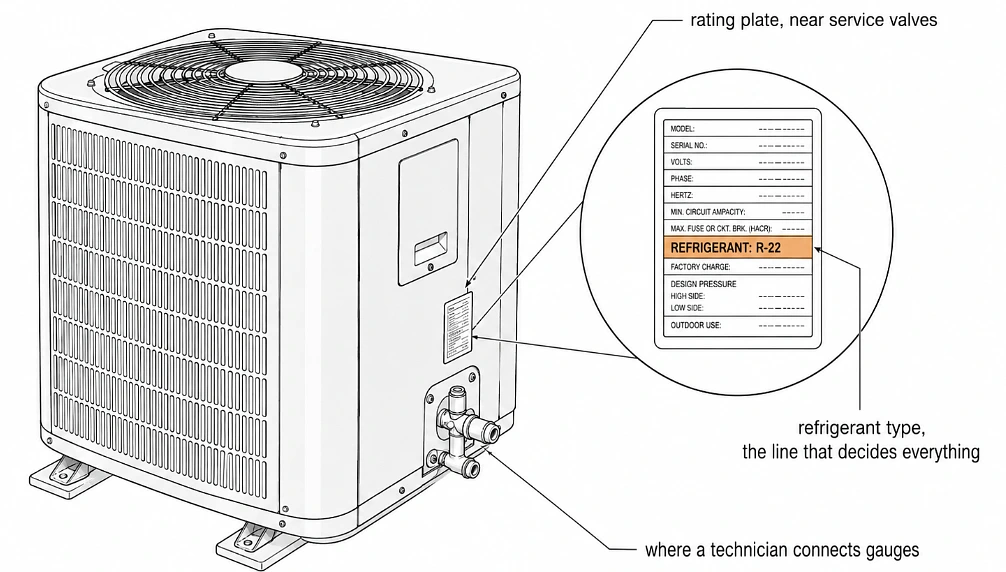
The sticker is sitting near the service valves on the outdoor unit and it has a refrigerant row on it, and if that row is saying R22 then this line is deciding everything for you.
The EPA phasedown pages explain why people are getting quoted $700 for a recharge and walking back into the house feeling robbed. R22 stopped being produced in 2020, what is left is whatever was made or reclaimed before the cutoff, and that scarcity has been pushing it to $90 to $150 a pound installed, against roughly $15 a pound back in 2010. A typical system is holding 6 to 12 pounds, so a recharge on a leaky R22 unit is running you $660 to $1,900, and the leak is still there when the truck is pulling away.
It’s crap, even understanding exactly why the price is what it is. You are renting cold air by the pound and someone is writing repair on the invoice. Parts for R22 equipment are drying up on the same schedule as the gas.
And the story does not end there, because R410A systems are now in their own federal phasedown while the new equipment is moving to R454B and R32, so anyone holding an old platform is going to be sitting where the R22 owners are sitting now, only a few years later.
When Replacing It Is The Cheaper Choice
A full replacement is running about $4,500 to $8,000 for a typical home, and yes, that is sounding like the expensive option, right up until you are adding up the 3 lines above. Run it for a 12 year old R22 unit over the next 5 years and the old system is losing. $500 a year in wasted electricity is $2,500, 1 repair a year at $600 is another $3,000, and 1 recharge somewhere in those 5 years is $1,000 at the cheap end, so that is $6,500 to keep a machine that is still 17 years old at the end of it, against $4,500 to $8,000 for a new one that has not even started saving on the bill yet. Refrigerant priced like cologne is what is tipping it.
One last thing before I conclude, one thing people are getting wrong at the buying stage without it turning into a sales pitch, and it is size. Bigger is not safer. An oversized unit is short cycling, it is cooling the air without drying it, and it is inflating the next 15 years of bills, which is why an energy-efficient AC installation service that is running a load calculation on your house before quoting matters more to you than any brand name on the box. If a quote is arriving without anyone measuring your house, you have the wrong quote in your hand, and it does not matter how good the price on it is.
 Decor & Improvement Accessories