

Home & Decor Blogs: DIY, Interior Design & Lifestyle Ideas
The Sensory-Soothing Home: Why Your Bedroom Needs to Sit Below 30 Decibels and 2700 Kelvin

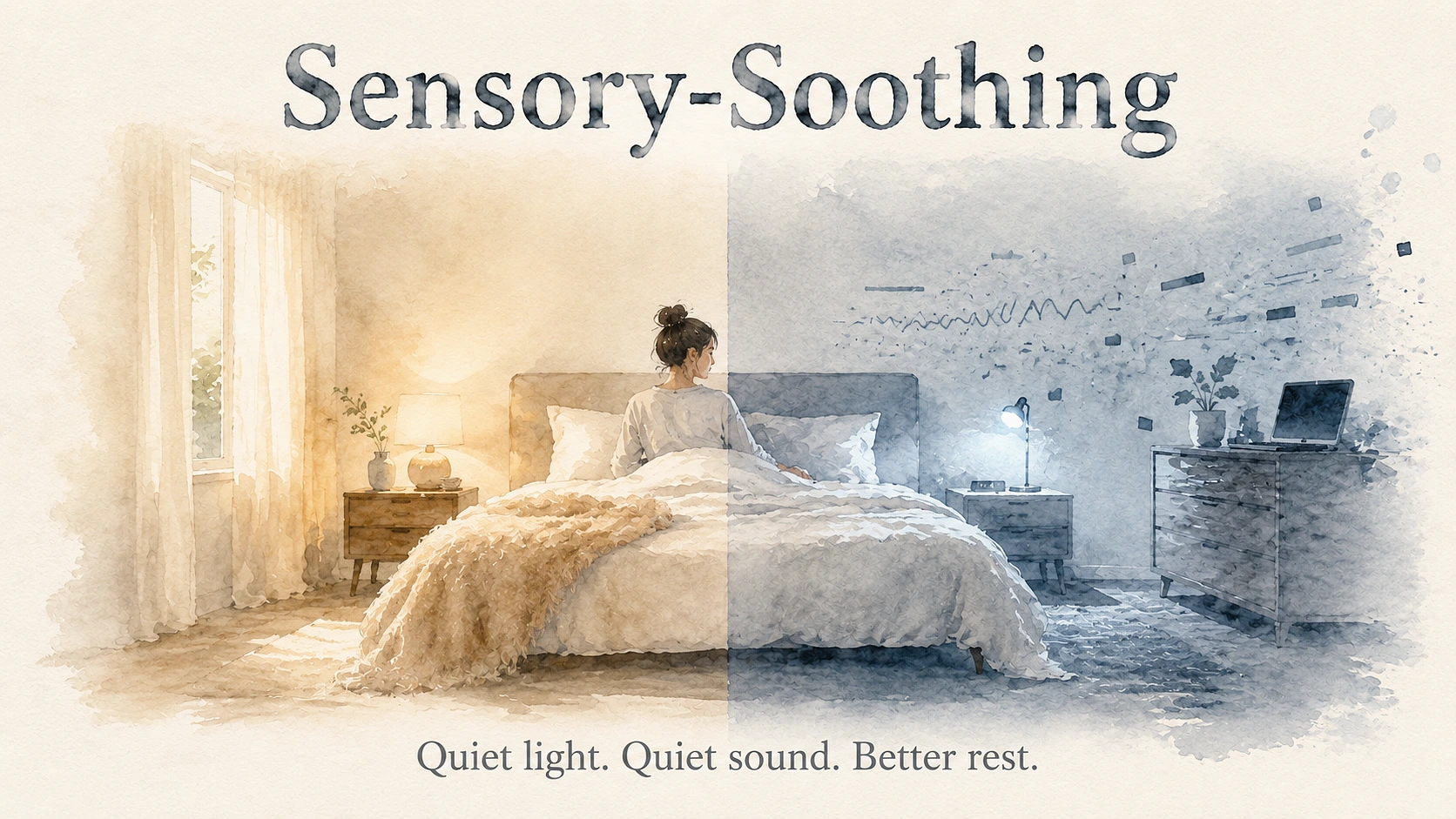
In the photos, a house can look terrific but in reality, it can be a nightmare to live in. The lights are too bright. The fridge is buzzing through the wall. The diffuser is over done, and that throw everyone likes is scratchy synthetic – you feel it throughout the night. Nothing is broken. You come home at the end of the day and the room is like, “Oh, you should be on” but you want to turn off.
That’s what it is. It is not about ugly or pretty – it is about a calm looking room or a calm feeling room. And it’s all about four senses. The five senses: touch, sight, sound, smell. If they’re correct, your body acknowledges that the room is fine, and releases. If you get one wrong, the other three suffer as well and most houses get at least one wrong and never find out which one.
That is the gap between “decorated” and “sensory-soothing.” A soothing home is not a style. It is a series of small decisions made, at four senses, touch, sight, sound and smell, either to allow the body to rest, or to be giving silent permission to not rest. Luckily, most of the fixes are financially low-cost, quick, and easily reversible. The bad news is that the majority of homes get at least one of the four things wrong and one wrong sense will cancel out three good ones.
Here are the actual changes that will take place, room by room, and the numbers that will count.
1. Texture Is the First Thing Your Body Reads in a Room
Before you even think about colour palette, or layout, your skin has already sent in a report. These are the surfaces that determine the breathability or bracedness of the room: Bedding, curtains, arm of sofa, bare feet on the rug.
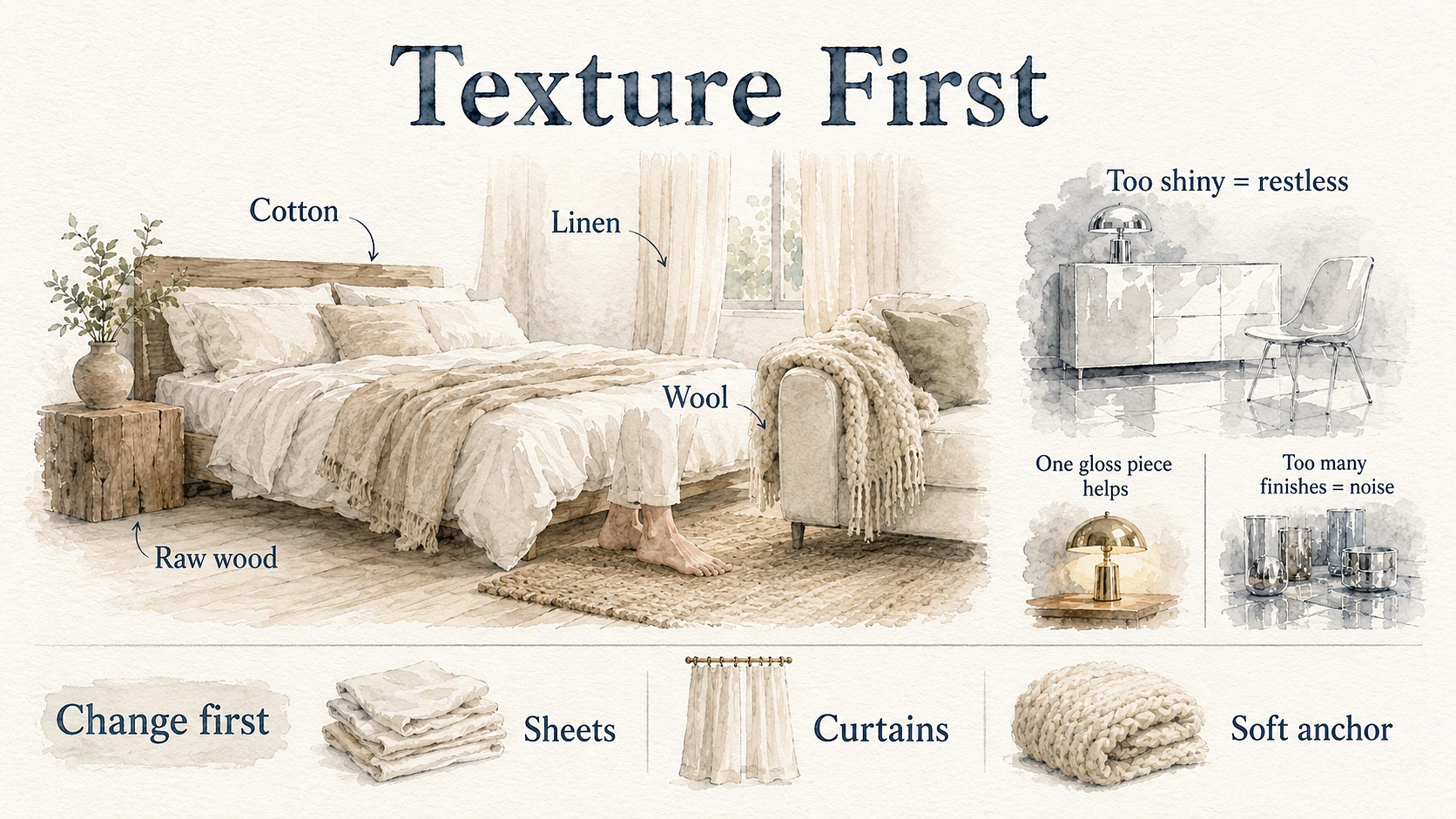
Natural fibres such as cotton, linen and wool read calm as they contain small irregularities that the eye does not have to strain to see. Raw wood is an exception to this rule as it reads energetic and dynamic. When the surfaces are very synthetic, particularly if they are shiny, it can make a room look as if it is spinning around even if everything is in order. It’s not the cleanliness. It’s the constant sameness.
The contrarian point on gloss
One piece of standard advice worth pushing back on: gloss is not the enemy. A shiny console under a window will reflect the daylight deeper into the space and make it easier to turn off the lights in the evening so the sound story and lighting story will work better later. The error lies in having too many shiny finishes, rough, patterned and shiny metallic finishes in the same frame. Choose a register and stick to it.
What to change first
- Bedding. If you only change one thing this week, change the sheets. Cotton percale or linen breathes; polyester traps heat and friction.
- Curtains. Heavy synthetic panels swap out for linen or cotton drape. The room sounds different the moment they are hung — more on that in section 3.
- One soft anchor per room. A wool throw, a sheepskin, a chunky-knit cushion. Something the hand wants to touch without thinking.
2. Lighting: Why 2700K Is the Real Bedroom Number
Of the four senses, this is the one where the science is the least negotiable. Your nervous system interprets the colour of light on the basis of special cells in the retina, and it’s not interested in your tastes. Cool and blue-light color signals the body that it is day, will block melatonin, increase cortisol, keep you awake. Amber is warmer, and allows the body to relax.
Colour temperature is measured in Kelvin (K). Every bulb prints its number on the box, usually in small type that most people never read. Lighting manufacturers recommend 2700K to 3000K for bedrooms, because warmer light supports the body’s natural evening melatonin production. Research on warm evening lighting has found people fall asleep meaningfully faster under it than under cooler, bluer light.
The Kelvin map, room by room
| Kelvin | What it looks like | Where it belongs |
| 1800–2200K | Candle, amber, sunset | Bedside accent light, the final hour before sleep |
| 2700K | Soft white, classic incandescent | Bedrooms, living rooms, dining rooms |
| 3000K | Warm white | Acceptable bedroom alternative; living rooms |
| 4000K | Cool white | Kitchens, bathrooms, task work — not bedrooms |
| 5000–6500K | Daylight | Offices, garages, work areas — not evening living spaces |
The mistake nearly everyone makes
Combining colour temperatures within a room. A ceiling light is 4000K and a table lamp is 2700K. We can’t put into words how it feels – it feels like something is off, it’s a little stressful, and most people don’t really look at the bulbs but at how their room is designed. Compare temperatures from all fixtures in a single space.
Layer, do not flood
One bright ceiling light is not lighting. It is interrogation. A calmer room uses three or four softer sources at different heights:
- A dimmable 2700K ceiling fixture, full only when you need it
- Two or more table lamps at 2700K with dimmer switches
- A low accent light — salt lamp, Edison bulb, amber smart bulb — at 1800–2200K, switched on in the last hour before sleep
That structure mirrors the way daylight fades in the real world. It is the single biggest lighting change a person can make in a weekend, and it costs less than a takeaway dinner if you already own the lamps.
3. Sound: Your Bedroom Should Sit Below 30 Decibels
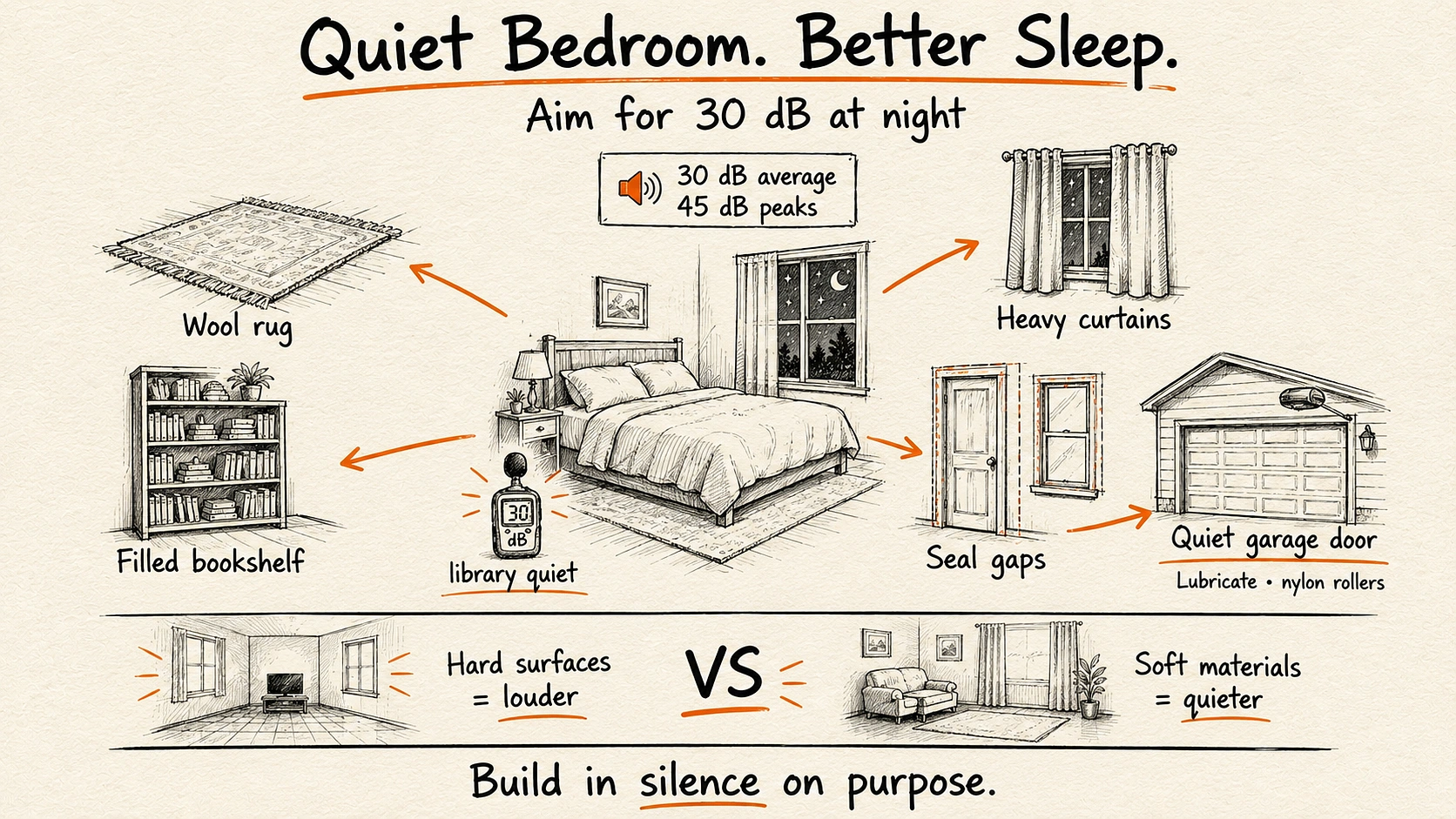
The sense most homes ignore is sound and it’s the one that can be backed up by the most obvious medical story. The WHO has recommended an average of 30 dB for noise in bedrooms indoors, and 45 dB for short duration noise peaks. This is about as quiet as a library, or soft wind rustling through the leaves.
Most bedrooms do not get there. Studies of indoor noise in residential settings consistently find homes sitting well above 30 dB at night — from fridges, HVAC, opener motors, traffic, neighbours. The body responds even when the conscious mind has tuned the noise out. Elevated cortisol, micro-awakenings the sleeper never remembers, and over years, measurable cardiovascular strain.
The materials trap
Hard surfaces reflect sound. Glass, tile, bare drywall, polished concrete — they make rooms feel sharper and louder than they need to. Soft materials absorb sound and pull the room’s acoustic floor down without anyone consciously noticing.
- A wool rug over hardwood drops the echo of every footstep
- Heavy curtains dampen window reflections and street noise at once
- A filled bookshelf against a shared wall is one of the cheapest sound buffers in existence
- Sealing gaps around doors and windows handles most outside noise that intrudes despite the curtains
The garage door problem nobody connects to sleep
For most, a noisy garage door is nothing too unusual. It is not. Many times, a garage door that grinds, rattles or bangs when it rolls makes its noise right into the next room, usually the bedroom or living room above it, and it’s one of the loudest predicted house sounds, except for a power tool.
The common culprits are not mysterious:
- Worn metal rollers that have lost their smooth glide and now drag along the track. Swapping them for nylon rollers cuts noise sharply — nylon is the standard for quieter operation.
- Loose hinges with oblong wear marks where the pin meets the bracket. Grey dust and small metal filings around the pin are the early warning sign.
- A slack chain on the opener, which slaps the track and jolts the rollers on every cycle.
- Dry moving parts, full stop. A silicone-based or lithium grease lubricant on hinges, rollers, and springs takes ten minutes and silences most doors immediately.
The first step is lubrication, and you can often reduce this noise by lubrication alone. But if the door still rattles even after applying a new lubricant to the hardware, then it is likely that the hardware is worn and needs to be addressed. This noise can be minimized with lubrication and a simple hardware inspection by a homeowner before seeking the services of an expert. Either way, a quieter garage door is one of the highest-yield acoustic upgrades in a house — it removes a recurring 70-plus decibel event from the day, every day.
Build in silence on purpose
Silence does work that background sound cannot. Turn the television off during meals. Carve out one chair, one corner, one window seat where nothing electronic runs. The point is not to live in monastic quiet — it is to give the mind a baseline to return to.
4. Scent: If You Can Smell It on Entry, It Is Already Too Strong
The sense that most people overdo is smell, perhaps because the “calm” products that are sold are designed to be noticed. The tranquility of a house isn’t shouted from the rooftops. The test is a simple one: walk in after an hour of walking outdoors. The room will smell of anything within the first 3 seconds if the source is too strong, either it be a diffuser, plug-in, a candle, or a heavily perfumed laundry detergent atop the base. Rising beats in a gentle, regular rhythm, with many different sounds in each, but only one sound per beat. Lavender has the strongest connotations of relaxation and so does vanilla and eucalyptus, but it doesn’t mean so much so much as the volume. Choose one fragrance register for a given fragrance, and place it quietly under everything else.
5. The One Mistake People Make Across All Four Senses
Sensory environments do not fail through any single sense. They fail through accumulation.
A living room can be beautifully lit, softly textured, and pleasantly scented — and still feel exhausting because the fridge in the next room is humming at 50 dB, or because the kitchen ceiling light leaking through the doorway is 4000K when the lamps in the room are 2700K. One mismatched element across four senses will undo three calm ones. The brain notices the conflict before the conscious mind does.
So it wasn’t ever intended to be about winning every category. It’s about not having one sense yelling while the others are mumbling. Forget to stroll the home truthfully and uncover the worst offender. The loudest of all things, the most piercing light, the strongest of all smells, the one surface that clings to you. Make one of them soft before you do. At the end of the day, the room does not work against you anymore, but rather, it works for you. And that’s why you came home in the first place.
 Decor & Improvement Accessories