

Home & Decor Blogs: DIY, Interior Design & Lifestyle Ideas
You Have 2 Weeks Left Before the Madison Frost – What an Ice Dam Is Really Telling You?
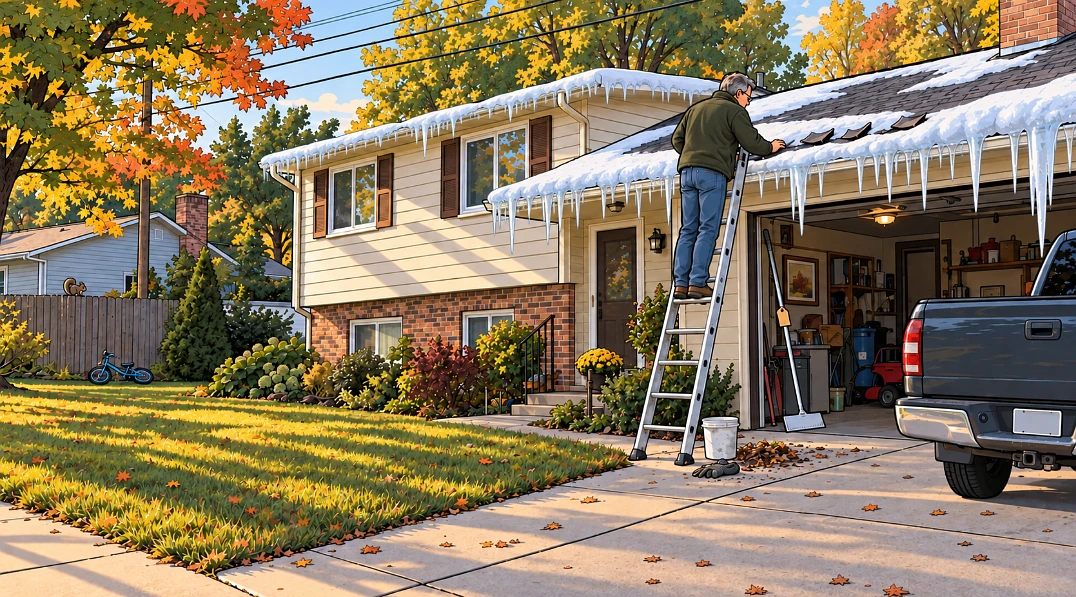
It’s 2 weeks. That is about how long Madison has left before the first frost, which lands around the first week of October most years, and it is the last stretch of the year when the attic is a place a person can stand to be in for an hour. I bring that up now, in September, because of a thing that happens in January in this state that everyone treats as weather and almost no one treats as a message. The ridge of ice along the edge of the roof, the icicles hanging off it 3 feet long, the brown stain that shows up on the bedroom ceiling a week later. That is an ice dam, and if you have had one, the house has been trying to tell you something about the attic since the winter before.
The roof did not fail. An ice dam is built by heat leaking out of the house into the attic, and the roof is only where the evidence ends up. So the fixes are mostly indoor fixes, they are cheaper than a roof, and the calendar for them is the next 10 weeks, before there is snow sitting on the shingles, which in Madison is late November.
How An Ice Dam Gets Built
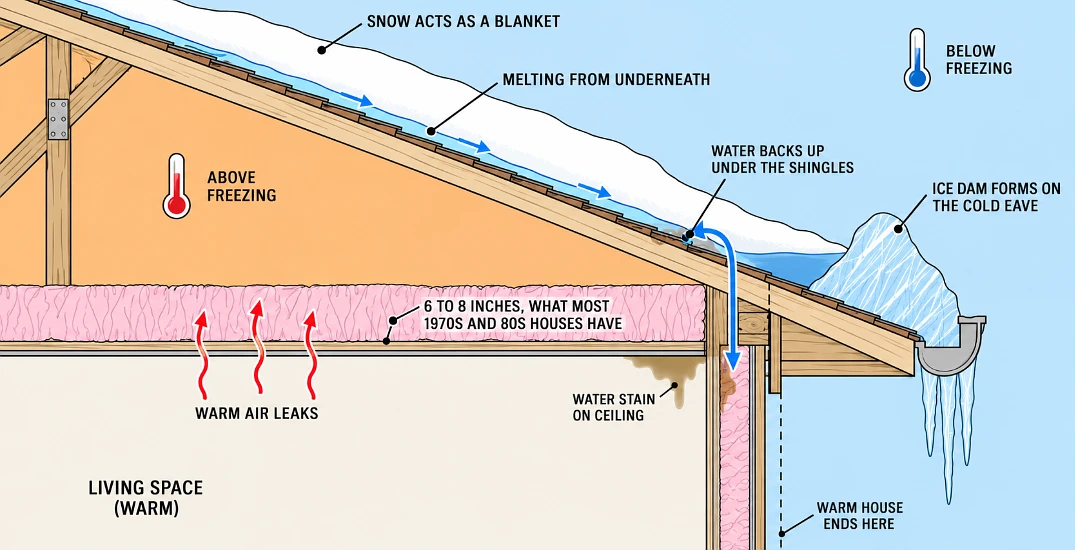
Snow on a roof is a blanket, and under a blanket things stay warm. If the attic below the roof deck is warmer than the air outside, which it is in most houses built before about 2000, the underside of the snow starts melting from the bottom, and the water is running down the roof under the snow until it reaches the eave. The eave is the part of the roof that sticks out past the wall, with no warm house underneath it, so it is as cold as the air, and the water freezes there. Every day of melting adds to the ridge, the ridge gets high enough to hold water behind it, and water that is standing on a roof goes where shingles were never built to stop it, up and under, and into the ceiling.
The Minnesota Commerce Department has a plain guide on this that every roofer in the upper Midwest has read, and its opening line is that the primary cause of ice dams is attic air leaks, warm moist house air escaping through the holes around plumbing vents, wiring and chimneys. Not thin insulation, though that matters too, and not a bad roof. Air leaks. It also says a thing that surprises people, which is that adding roof vents, including the powered ones, will not get rid of the dams and often makes them worse, because a vent is pulling more warm house air up through the same holes.
So the question people are asking in January, whether the roof needs replacing, is usually not the one to be asking in January, and the one that matters, where the heat is getting out, gets answered from inside the attic with a flashlight.
Where The Heat Is Getting Out Of Your House
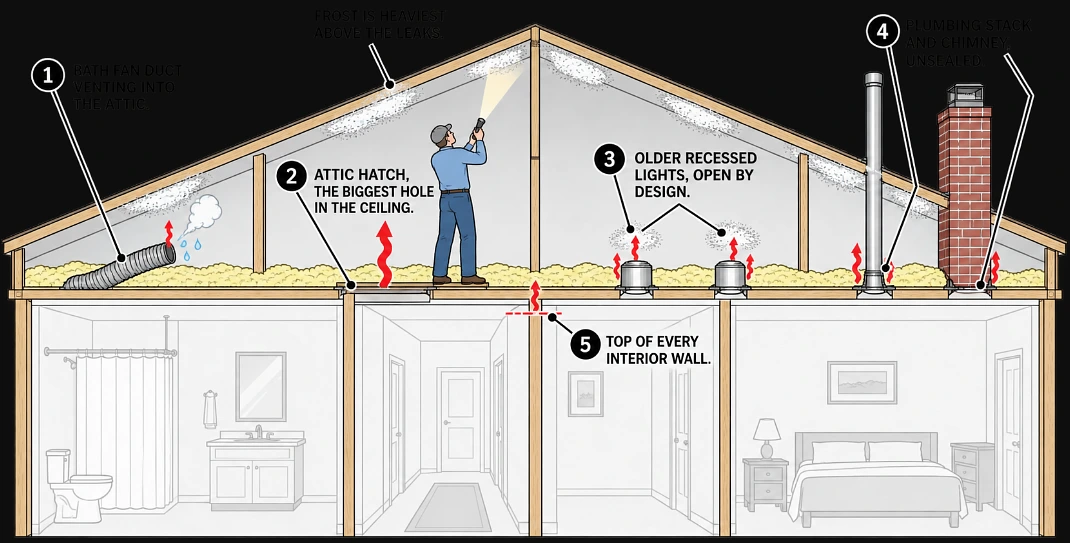
Go up into the attic on a cold morning with a flashlight and the leaks are almost visible, because the frost on the underside of the roof deck is heaviest right above them, and in an old house the insulation is stained dark where air has been moving through it for 40 years. The usual ones, in the order they matter:
- The attic hatch, which in most houses is a square of plywood sitting on trim with a half inch gap all the way round, and it is the single biggest hole in the ceiling.
- Recessed can lights, the older ones especially, which are open to the attic by design and are pouring warm air up around the bulb all evening.
- The bathroom fan duct, which is either venting into the attic instead of out through the roof, or is a flexible hose that has come off the roof cap, and either way it is putting a shower’s worth of warm wet air into the attic twice a day.
- The plumbing stack and the chimney, where the hole cut through the ceiling was never sealed around the pipe.
- The top of every interior wall, where the drywall meets the framing and a gap runs the whole length of the house.
The fixes are foam and caulk and a few hours, and they come before any insulation goes in, because insulation is a blanket and a blanket over a hole is doing nothing for the hole. Seal the leaks first and the same insulation that was useless last winter starts working. Once the sealing is done, the target for this climate is R-49 to R-60 of insulation on the attic floor, which is 16 to 20 inches of blown cellulose or fiberglass, and most 1970s and 80s houses in Madison are sitting at 6 to 8 inches. Half of what they need, or a little less.
The 2 Weeks Before The Frost
Whatever needs warm weather gets done now, and there are only 2 things on that list. The first is the roof itself, from the ground and from inside the attic, looking for the shingles that were lifted by last winter’s dam, the flashing at the chimney and where the roof meets a wall, and whether there is a membrane under the shingles at the eave at all, which a roofer can tell from the edge and a homeowner usually cannot. The second is anything on the outside that needs caulk or sealant, because sealant applied at 40 degrees does not cure and sealant applied at 60 does.
Gutters get their first clearing now too, so the October leaves are the only thing in them by November, and if a downspout is dropping water at the foundation, an extension goes on now while the ground is soft enough to move it away from the house.
October, Before The First Flurries
The attic work is indoor work, so it runs right through October, and October is when it gets done in this state because the first flurries are landing between the 15th and the end of the month and the attic is a miserable place once the roof deck is cold. Sealing first, a weekend for a handy owner or a day for an insulation contractor, then the insulation topped up, and the bath fan duct run to the roof cap with a real rigid duct if it was a flexible one.
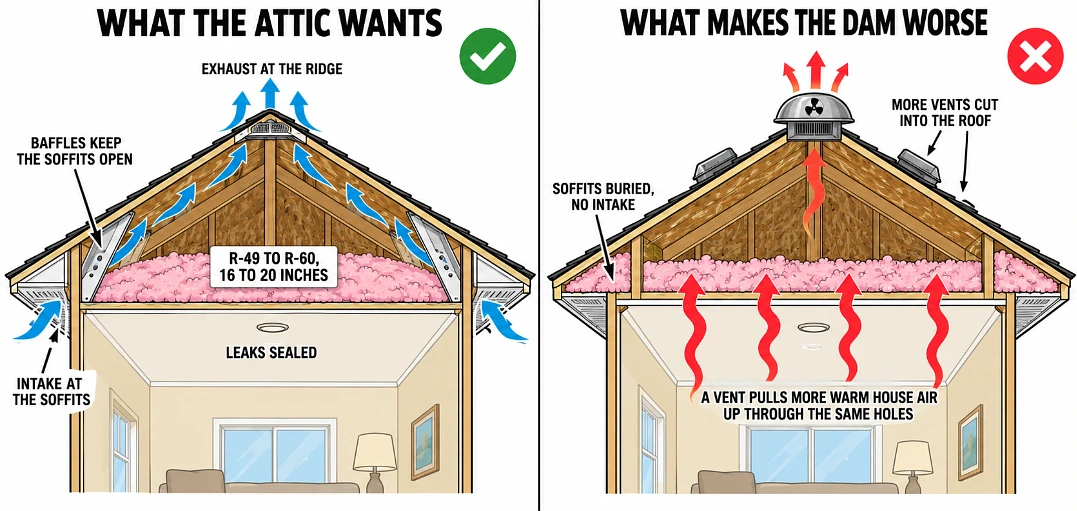
Do the vents need attention at the same time? Yes, but not more of them. What an attic wants is intake at the soffits, the underside of the eaves, and exhaust at the ridge, with the soffit vents kept clear by baffles so the new insulation does not bury them, which is the mistake that turns an insulation job into a moisture problem. More vents cut into the roof are not on the list, and the Minnesota guide is blunt about why.
Gutters get the second and last clearing at the end of the month, once the leaves are down.
November, Before Snow Sits On The Roof
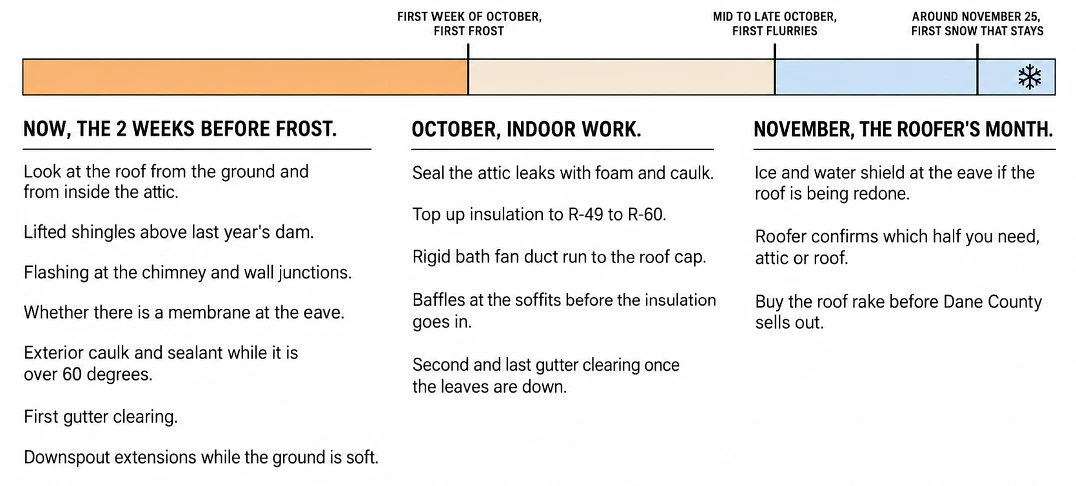
The first inch of snow that stays lands in Madison around November 25 on average, and the month before it is the roofer’s month, because after it the eave is under snow until March and no one is looking at it. If the September look at the roof turned up lifted shingles above last year’s dam, or no membrane at the eave, this is the visit for it, and the roofers in Madison WI who do this work are putting down an ice and water shield, a self sealing membrane that runs from the eave up past the wall line, so that when a dam forms anyway the water backing up behind it is sitting on the membrane and not on the ceiling. It goes on when the roof is done or redone, it cannot be slipped under existing shingles, and it is the roof half of the fix, the attic being the other half.
A good roofer in that visit is telling you which half you need. If the attic is leaking heat, new shingles on their own are getting the same dam next February, and a roofer who says that in the driveway has been up the hatch and looked, which is the check to ask for.
November is also when the roof rake gets bought and hung on the garage wall, an aluminum blade on a 16 foot pole, about $50, and the reason it is bought in November is that by the second week of January the hardware stores in Dane County have sold out of them.
What To Do When A Dam Forms Anyway
Because it can, in the first winter before the attic work is finished, or in a hard winter when the snow sits on every roof in the state for weeks at a time.
The Roof Rake
After every snowfall of a few inches, the rake pulls the first 3 or 4 feet of snow back off the eave from the ground, and no snow at the eave means nothing to freeze there. It is the one thing that is done from the ground with feet on the driveway, and it is the only outdoor ice dam job I would do myself.
The Calcium Chloride Sock
If a ridge has already formed, a leg of old pantyhose filled with calcium chloride, the same pellets sold for sidewalks, laid across the dam so it hangs over the edge, melts a channel through the ice in a few hours and lets the water behind it drain. It is a temporary channel and it has to be replaced after the next snow, but it stops the water going into the house that week. Rock salt is not a substitute, it eats the shingles and the plants under the gutter.
What Not To Do
A hammer, a hatchet, a chisel, or anyone standing on a ladder on ice with any of those. The ice comes off with pieces of the shingle and the gutter attached to it, the roof is worse in March than the dam would have left it, and every winter in Wisconsin someone goes to the hospital doing it. If a dam is putting water into the house right now and the sock has not cleared it, a roofing company with a steamer takes it off in an hour without touching a shingle, and that call is cheaper than the ceiling.
Which brings it back to the attic, and to the next 2 weeks, since a house that gets the sealing done in October is a house whose roof rake stays on the garage wall most winters.

 Decor & Improvement Accessories