

Home & Decor Blogs: DIY, Interior Design & Lifestyle Ideas
What Breaks First in Ottawa Homes Built Before 1980 — and What It Costs to Fix
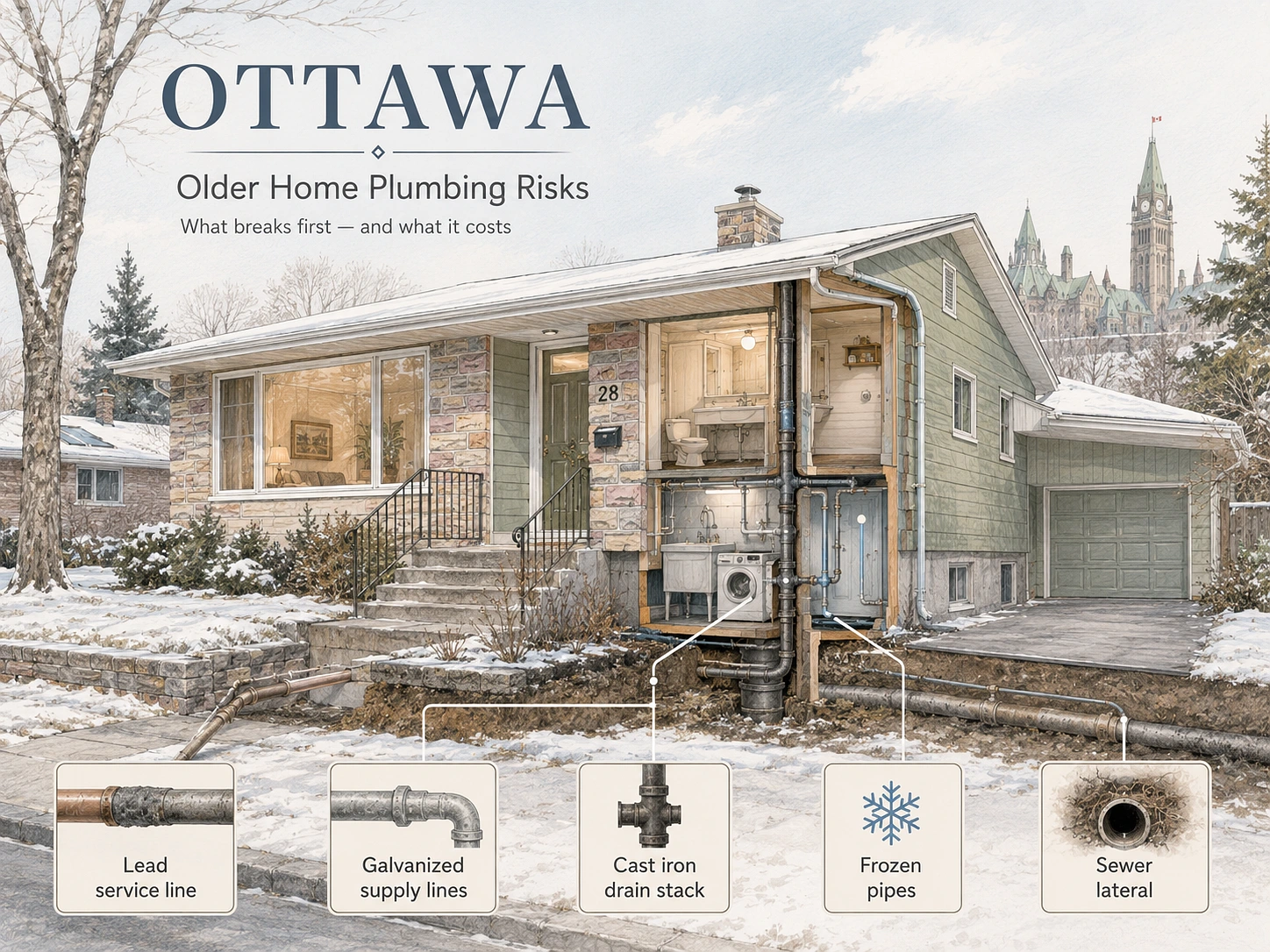
Open the City of Ottawa’s lead pipe replacement page and the figure sitting on it is that about 15% of homes in the city were built with a lead water service pipe, nearly all of them before 1958, and a house built after that can still have a lead public portion if the watermain in the street has never been replaced. The City has a rebate and a loan for taking it out, and most of the people we have talked to in those neighbourhoods had never heard of either.
The lead pipe is 1 of 5 things that can be wrong with the plumbing in an older Ottawa house, and each of the 5 is on its own clock:
- Galvanized steel supply lines, put in from the 1930s to the early 70s.
- Cast iron drain stacks from the same years.
- Copper supply lines joined with lead solder, common right through to the mid 80s.
- The clay or cast iron sewer lateral under the front lawn.
- And the Ottawa winter, which works on all 4 of the others every January at minus 25 and colder.
Galvanized Supply Lines Were Built For 40 To 50 Years, And Yours Are Past That
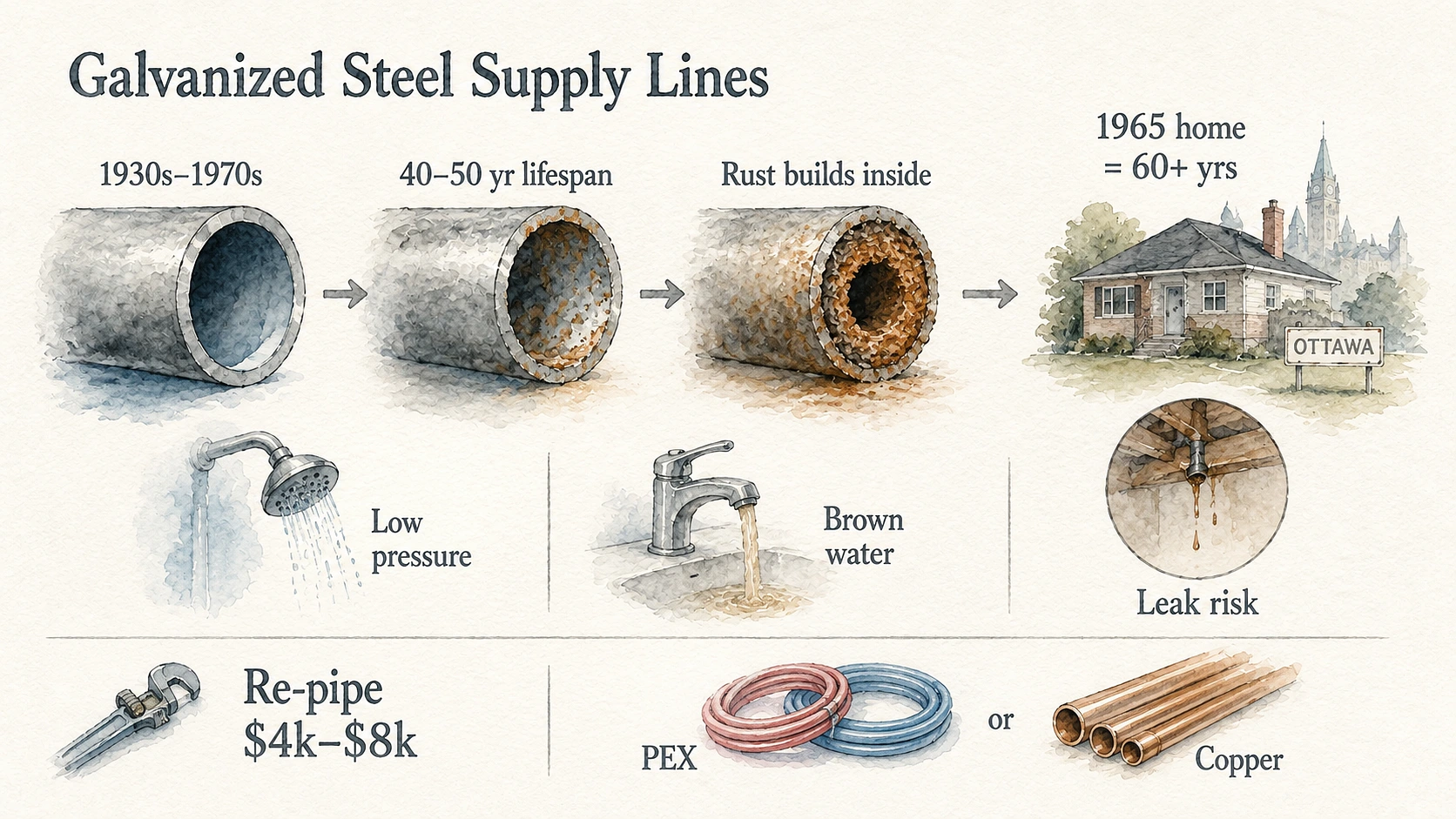
Run the shower and the basin tap at the same time and watch what the shower does. If it drops to a dribble while the basin keeps going, and the same thing has been happening at the kitchen sink when the washing machine fills, the pipe has narrowed along its full length, and that is what galvanized steel does in its 5th and 6th decade. The pipe is steel with a zinc coat, and the zinc was meant to keep the steel from rusting, which it did for 30 or 40 years, and then it wore through and the steel underneath has been rusting from the inside ever since, building up scale that closes the pipe the way a furred kettle closes its spout.
So is it the showerhead? If only 1 fixture has gone weak, it might be, a showerhead clogs on its own and so does a tap aerator. If every tap in the house has dropped together over a year or 2, it is the pipe. The other sign comes in the morning, brown or yellow water for the first few seconds out of a tap that has sat overnight, which is rust that has settled in the pipe flushing through, and if it clears inside a minute the pipe is corroded but still doing its job, whereas water that stays coloured means pieces are breaking off all day.
A house built in 1965 with its original galvanized lines is now past 60 years on pipe that was rated for 40 to 50, so it will go 1 of 2 ways, either as a slow pressure drop you can plan around, or as a pinhole behind the drywall that you will find when the ceiling below it starts to drip. A full re pipe of a 2 storey Ottawa house, galvanized out and copper or PEX in, has been running $4,000 to $8,000 depending on how many fixtures there are and how many walls have to be opened to reach the runs. PEX comes in cheaper because it bends round corners instead of needing a soldered elbow at every turn, and some owners would still rather pay for copper.
Cast Iron Stacks Rust From The Inside, And You Hear It Before You See It
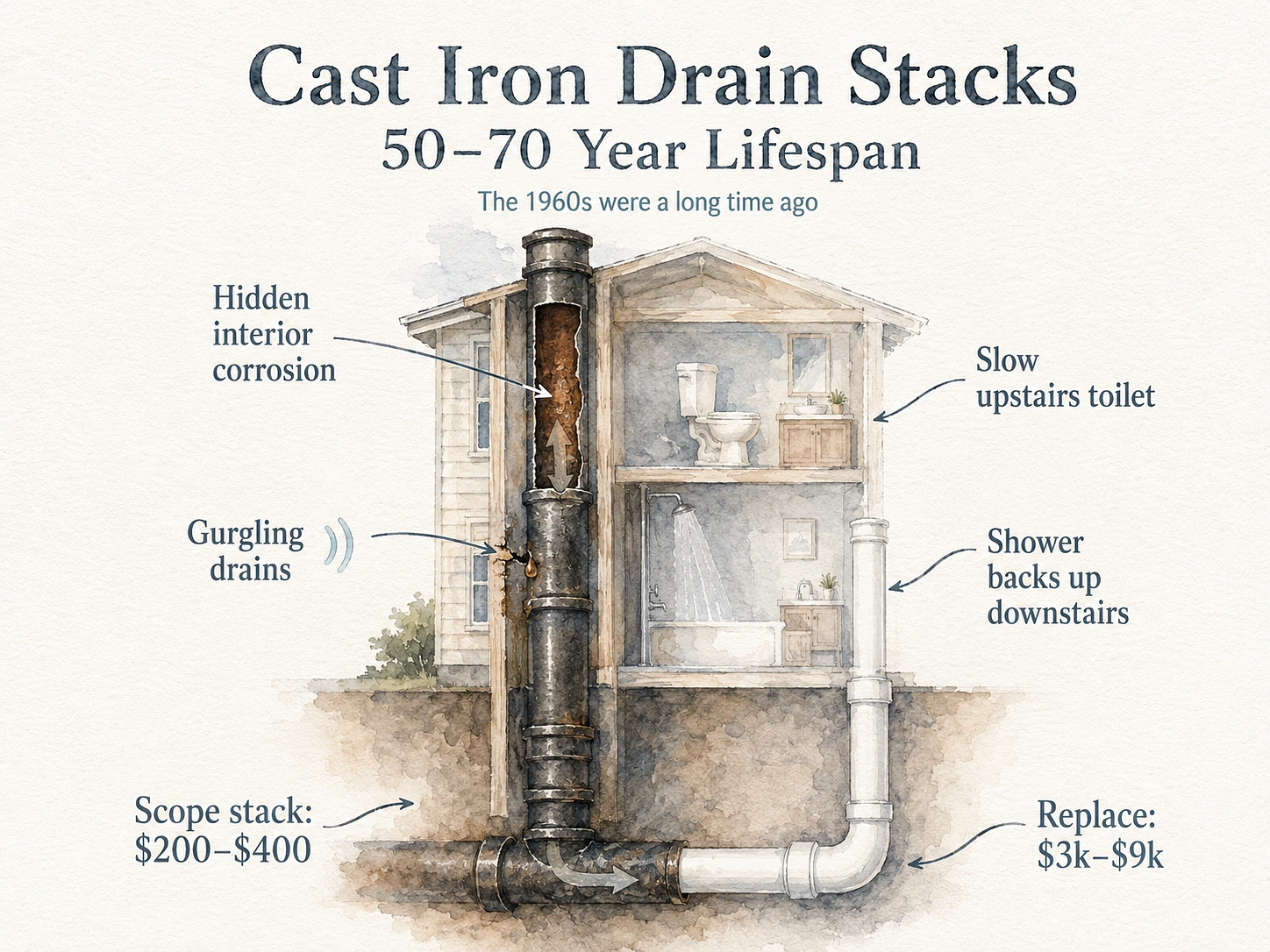
A gurgle from the basin after the upstairs toilet flushes, a toilet that drains slowly even after the trap and the branch have been cleared, water rising in the ground floor shower tray when someone flushes above it. Those 3 are the stack talking, the big vertical pipe that carries everything from the upstairs bathrooms down to the sewer, and in a house built before the mid 1970s it is cast iron.
Cast iron can last 100 years in a dry museum. In a drain it is more like 50 to 70, because of what has been going down it, and it rusts in a way you cannot see, from the inside, while the outside of the pipe still looks solid enough to lean a ladder on. The rust does 2 things in there. It roughens the bore, so grease and paper that would have slid down a smooth pipe now catch on the rough patches and start to build a ring, and the ring narrows the pipe a little more each year.
Then the wall thins until a section cracks or a joint lets go, and at that point the sewage is inside the wall cavity.
Taking a main stack out and putting PVC in has been costing $3,000 to $9,000 in Ottawa, the low end for a stack standing exposed in an unfinished basement and the high end for a stack buried in finished walls across 2 storeys, where most of the bill is the drywall and the labour of cutting heavy iron in a space the width of a stud bay while holding up the section above it. The PVC itself is nearly free.
Before any of that, scope the stack. A camera down the main stack costs $200 to $400 and tells you whether you have 1 blockage or a pipe corroded end to end.
Most owners keep snaking individual drains year after year instead, and if you are calling a plumber in Ottawa for the third backup in 2 years, the camera will tell you more than another round of snaking would.
Lead Service Pipes And Lead Solder Are 2 Different Jobs With The Same Risk
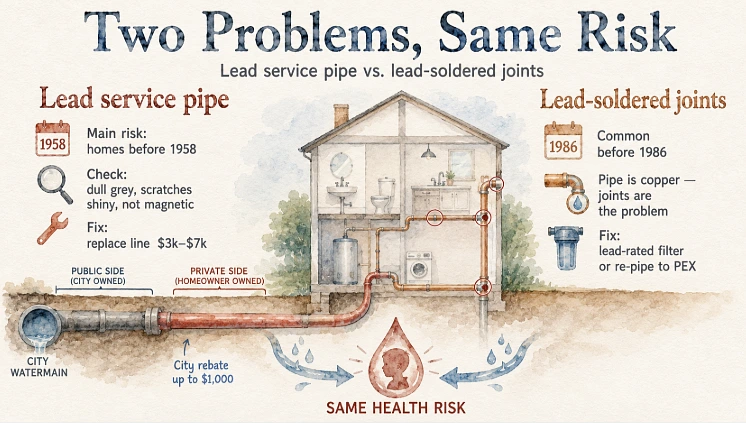
The service pipe is the one underground, from the City’s watermain in the street to the wall of your basement, and it has 2 halves. The City owns the half from the main to the shut off valve, and when it replaces the watermain it swaps its half for copper. You own the half from the valve to the house, and if you do not pay to replace it, it stays lead, and the water that has sat in it overnight picks up lead on the way to the kettle. The City’s own test for finding out what you have is on the page linked above, and it is simpler than the kits:
Scratch the pipe with sandpaper to expose bare metal. The only visible section is between the basement’s concrete floor and the water meter. Lead is dull grey and easily scratched by a hard object. Copper is red brown, with possible green deposits on corroded areas.
Galvanized steel is grey as well, but a fridge magnet will stick to it and will not stick to lead. What the City will do about it, from the same page:
- A rebate of up to $1,000 on the private half, which the City itself puts at about 20% of the cost, when the public half is already copper or booked for replacement within 2 years.
- Where both halves are lead and get done together, a loan of up to $5,000 paid back over 5 years on the property tax bill, and a longer term above that.
- Families with children under 6, or a baby on the way, go to the front of the queue.
- The private half has been costing $3,000 to $7,000 to dig and replace, depending on how long and how deep the run is.
The solder is the second problem and it reaches far more houses. Copper lines put in before the mid 1980s were joined with lead solder at every elbow and tee, the National Plumbing Code allowed it until 1986, and the pipe is fine while the joints are not, especially on the hot side and in water that has stood overnight. No one re solders an entire house, there could be 200 joints in it. The 2 real fixes are a whole house filter certified for lead, which is the interim answer, or a re pipe to PEX, which takes every solder joint out of the system at once.
The Ottawa Winter Freezes Every Material, And It Starts At The Rim Joist
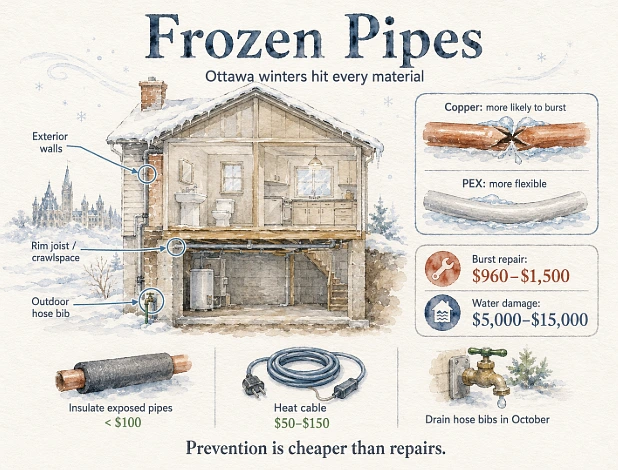
January lows here sit around minus 14 or 15, and the cold snaps that go to minus 25 and minus 30 arrive a few times most winters, and those are the nights the phone rings. Copper splits when the water inside it freezes, because copper is rigid and ice is 9% bigger than the water it came from, so the pipe has to give somewhere and it gives at the weakest point. PEX has some stretch in it and will take a small freeze without cracking, which is a large part of why it has become the default for re pipes in cold cities.
Where it freezes:
- Supply lines running inside an outside wall, worst on the north and west faces where the wind comes from.
- Pipes near the rim joist in an unfinished basement or crawlspace.
- Outside hose bibs that were never shut off and drained in October, the ice forms at the bib and grows back along the pipe into the wall.
The rim joist deserves its own sentence, because it is the coldest spot in nearly every Ottawa basement and most owners have never looked at it. It is the band of wood sitting on top of the concrete foundation wall, where the floor joists rest, and on an older house it has no insulation on it at all, so the outside air is 1 plank away from whatever pipe has been run along it. A copper line clipped to that joist will freeze on a minus 28 night while the furnace is on and the rest of the basement is warm.
A burst that a plumber can reach without demolition has been running somewhere around $1,000 to $1,500 to repair. The number that matters is the other one, a burst inside a finished wall that ran for a few hours before anyone noticed, because that is drywall, paint, sometimes mould work, and it has been costing people $5,000 to $15,000. Foam pipe sleeve on the exposed runs is under $100 of material and a Saturday afternoon, heat cable on the worst section another $50 to $150, and shutting off and draining the hose bibs costs nothing, and all of it has to be done in October, because by the night it freezes it is too late.
The Sewer Lateral Under The Lawn Is Clay, And The Trees Have Found It
The lateral is the pipe from your house to the sewer main, usually under the front lawn, and in a house from before the 1970s it is clay or cast iron, both good for 50 to 70 years in the ground, and both with joints every few feet that a root can get into. Ottawa’s older streets have the trees for it. A root finds the gap at a joint, grows in, and once inside it keeps growing and catches grease and paper until the line backs up into the basement. You snake it, the backup clears, and 6 months later it is back, because the root is still there and still growing through the same joint.
The way to know is a camera, run from the cleanout in the basement out to the City connection, which shows where the roots are coming in, whether the pipe has sagged in the middle (the trade word is bellied), and whether the damage is 1 joint or the full run. Lister Plumbing lists drain camera inspections and sewer line replacement on its page, and a scope is a separate request from a standard home inspection, which does not include one. A failing lateral is a $5,000 to $15,000 repair that a home inspector will not find unless you have asked for the sewer scope on top.
What can be done once the camera has seen it:
- Trenchless lining, a resin soaked liner pulled through the old pipe and inflated so it sets as a new pipe inside the old one, $4,000 to $8,000, no digging, and it works while the pipe is cracked and rooted but has not collapsed.
- Dig and replace, the lawn opened, the clay lifted out, new PVC laid, $8,000 to $15,000 depending on depth and length and whether the City sidewalk or your driveway is sitting on top of the run, and it is the only option once the pipe has collapsed or bellied so far that a liner cannot follow it.
Which Problem To Fix First
A 1950s or 1960s house in Ottawa could have all 5 at once:
- A lead service pipe.
- Galvanized supply lines.
- A cast iron stack.
- Lead soldered copper joints.
- A clay lateral with roots in it.
Doing the lot in 1 go would be $20,000 to $40,000, which almost no one does, so the order has to be decided, and we would decide it like this.
Health first, then whatever can flood the basement, then the planned re pipes.
Health first means the lead, the service pipe through the City’s rebate or loan, and a lead rated filter on the house while the solder joints wait for the re pipe. Then the 2 things that make a single bad night cost more than 10 years of weak showers, the lateral if the basement has backed up more than once, and the pipe sleeve and hose bibs before the first winter in the house. The galvanized re pipe and the stack can wait for a planned job, quoted in May when the plumbers have stopped running to freeze calls, with 3 quotes that name the material, the permit and the warranty, and the quote that names none of them goes to the bottom of the pile.

 Decor & Improvement Accessories