

Home & Decor Blogs: DIY, Interior Design & Lifestyle Ideas
How Much Ventilation Your Garage Workshop Actually Needs, And Why A Bathroom Fan Was Never It
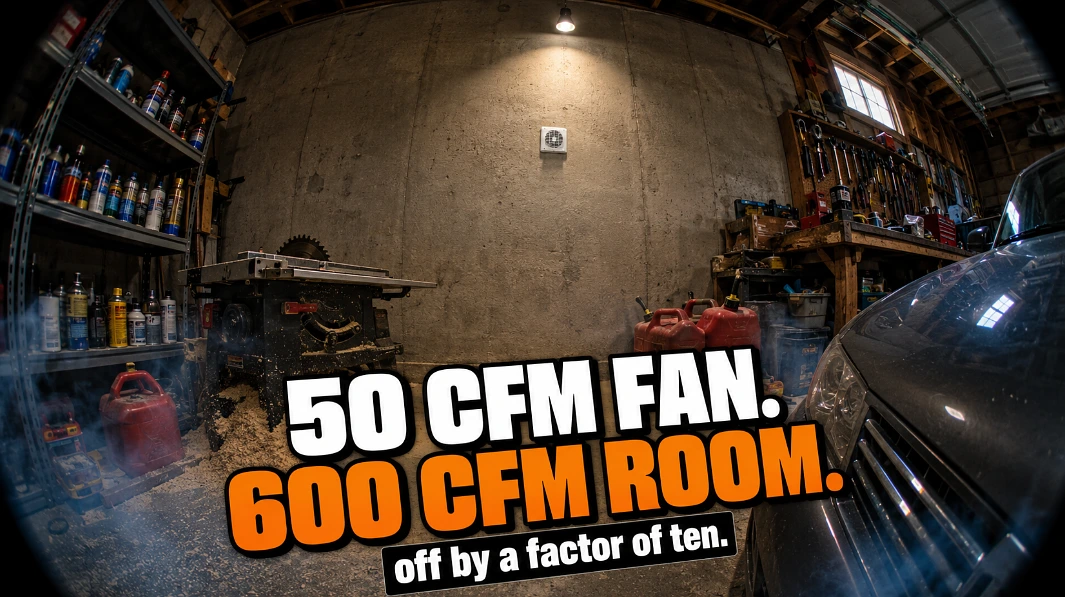
Quick answer: a garage used as a workshop needs its full air volume replaced roughly 10 to 15 times an hour, which for a standard two car garage works out to several hundred CFM of exhaust capacity. A bathroom style fan moves 50 to 110 CFM. That is the whole problem in two numbers. The most contaminated air in your house is in the garage, and the fan most people put there was sized for shower steam.
Think about what actually happens in that room. A car runs for thirty seconds while you back out. Spray paint, stain, solvent, gas cans, the mower. Sawdust if there’s a table saw. Carbon monoxide has no color and no smell, solvent vapors pool in the dead corners near the floor, and fine dust hangs long after the tool stops. It is the one room in the house generating industrial style air problems, and it is also the room that usually has zero mechanical ventilation at all.
Yes, Your Garage Needs Real Ventilation Even Though Code Does Not Demand It
The building code will not force you. The IRC does not require mechanical ventilation in a residential garage, which is why builders almost never install any.
The EPA disagrees with the silence. For an attached garage, the EPA’s recommendation is a minimum 70 CFM exhaust fan running continuously or triggered by motion, because an attached garage shares walls, and often a door, with the rooms your family sleeps in. Whatever builds up in there does not politely stay in there.
So the honest position is this. No ventilation in a garage is legal in most places, and it is still a genuine risk the moment that room does anything beyond storing a parked, cold car.
The Formula: CFM Equals Garage Volume Times Air Changes, Divided By 60
This is the number people search for, so let’s just do it.
CFM needed = (length x width x height in feet x air changes per hour) ÷ 60
The air changes per hour depend on what the garage does:
- Parking and storage: 6 to 8 air changes per hour
- Workshop with power tools: 10 to 15
- Spray painting or heavy solvent work: 15 to 20
Now the worked example, because the abstract formula hides how big these numbers get. A standard two car garage, 576 square feet with 8 foot ceilings, holds 4,608 cubic feet of air. At general use rates that already demands roughly 460 to 615 CFM. Push it to workshop rates and you are near or past 1,000 CFM. Spray painting, higher still.
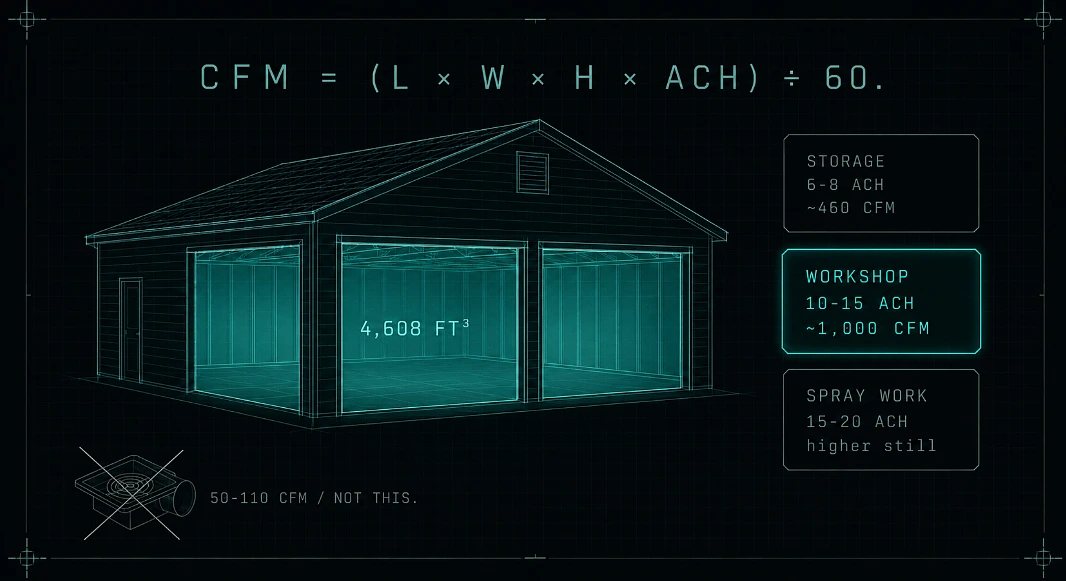
Hold that against the bathroom fan again. Fifty to 110 CFM. It is not a little undersized for this room. It is off by a factor of five to ten.
Why A Ceiling Fan Or A Cracked Door Does Not Fix Carbon Monoxide
But the air feels like it’s moving, so isn’t that enough?
No, and the distinction matters enough to be blunt about it. Circulation is not ventilation. A ceiling fan stirs the contaminated air around the room. It removes nothing. Carbon monoxide management needs air that actually leaves the building, replaced by fresh air coming in, which only an exhaust fan pushing outdoors can do.
The cracked garage door is half right, which is why the myth survives. An open door is a fine intake. It is just not an exhaust. Pair a door opened six to twelve inches with a powered exhaust fan mounted high on the opposite wall and you have a real system, fresh air pulled low across the room and contaminated air pushed out the far side. The door alone, with nothing driving the air out, mostly lets the fumes sit.
The Fan That Actually Fits The Job
Once your math lands in the hundreds of CFM, you have left the residential fan aisle entirely, and the product built for this is the shutter mounted wall exhaust fan, the kind with gravity louvers that snap shut when the motor stops. They start around a few hundred CFM and run into the thousands, they are built for continuous duty and dusty air, and suppliers like Industrial Fans Direct carry them from small workshop sizes up to full shop scale, which is exactly the range a serious garage lands in. The louvers matter more than people think, they are what keeps the garage from becoming a wind tunnel to the outdoors every hour the fan is off.
Two buying notes worth more than any brand comparison. Rated CFM is a free air number, a fan advertised at 650 CFM delivers noticeably less once it is pushing through louvers and any ducting, so size above your calculation, not at it. And check the sone rating, under 3 sones stays tolerable for a workshop, under 2 if the garage sits below a bedroom, because a fan too loud to run is a fan that protects nothing.
Mounting It So The Air Actually Sweeps The Room
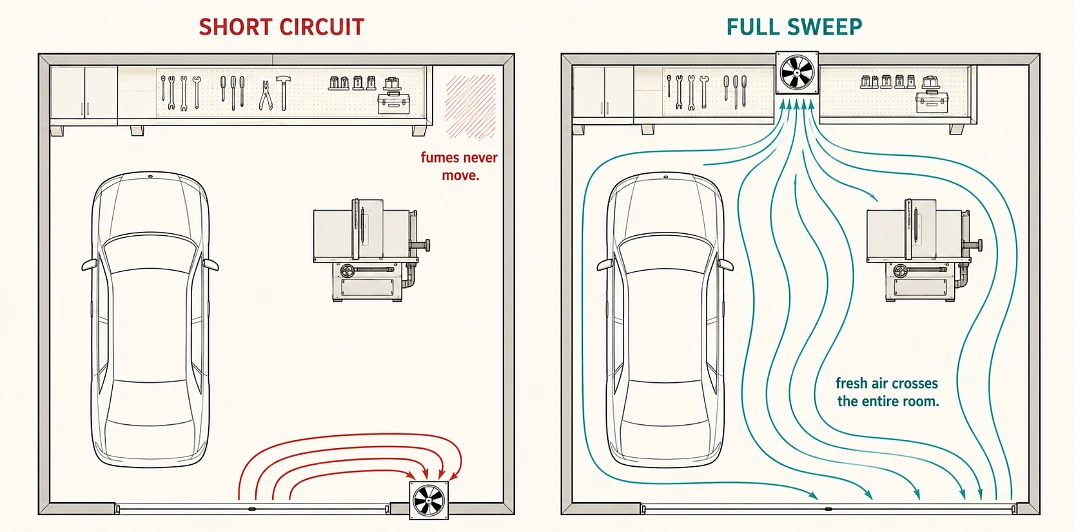
Placement decides whether your CFM does its job. High on the wall, because that is where heat collects, and on the wall opposite your intake, so fresh air has to travel the length of the room to reach the exit. Air takes the lazy path, and if the intake and exhaust sit next to each other, the fan happily recycles the same corner of clean air while the fumes at the far bench never move.
If the garage sees engine running or solvent work, add a CO detector regardless of how good the ventilation is. It is a twenty dollar backstop for the days the fan is off and someone warms up the car anyway.
The bathroom got its dedicated fan decades ago and the humidity in there mostly threatens the paint and the vanity. The garage got nothing, and what builds up in it can reach the bloodstream. Sort the room by what the air in it actually carries, and the garage should have been first in line the whole time.

 Decor & Improvement Accessories