

Home & Decor Blogs: DIY, Interior Design & Lifestyle Ideas
What Alaska Property Owners Do in the Six Weeks Before Freeze Up

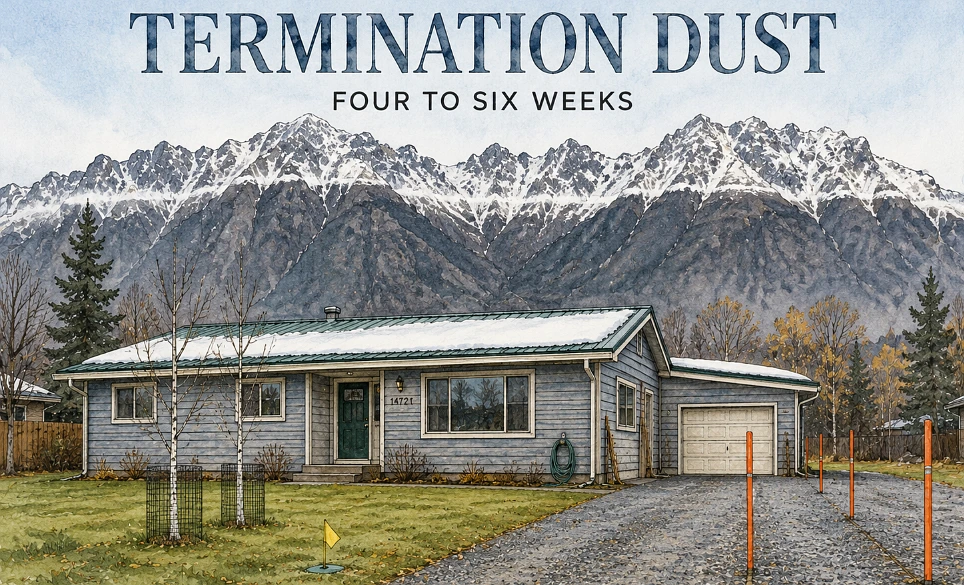
Termination dust shows up on the Chugach in early September. That’s the first snow line on the peaks, visible from anywhere in the Anchorage Bowl, and locals treat it as the official countdown clock. From the day you see it on the mountains, you have roughly four to six weeks before the ground freezes for the winter.
Most property damage that shows up in spring traces back to something that should have been done in those six weeks and wasn’t. Cracked backflow preventer. Foundation hairlines from ice jacking. Bark stripped clean off a young birch by moose. Snow mold colonies the size of dinner plates across the back lawn. None of these are random. All of them are timing failures.
Here’s what the schedule actually looks like for a property in Anchorage, Eagle River, Wasilla, or anywhere across South Central, working backwards from the freeze date.
Mid September to Late September
Irrigation blowout before the first hard freeze
The first hard freeze in Anchorage averages September 26 to October 5 based on NWS climate data for the area. That’s the deadline for clearing every drop of water from underground irrigation lines. Not the suggestion. The deadline.
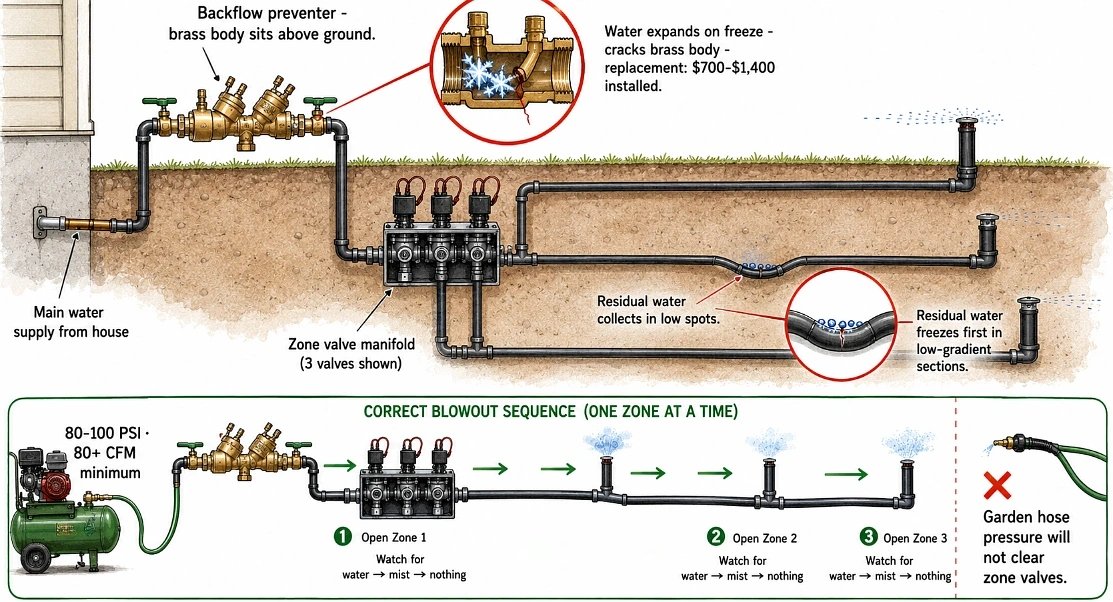
The problem isn’t the lateral lines. Those are usually flexible enough to survive a partial freeze. The problem is the backflow preventer, a brass assembly sitting above ground where the system ties into your main water supply. Water trapped inside a backflow preventer expands when it freezes and cracks the brass body. A replacement runs $400 to $900 for the part and another $300 to $500 for installation because it requires shutting down the main and pulling permits in most municipalities.
A garden hose attached to your spigot will not blow out an irrigation system. The pressure required to push water through zone valves and reach the furthest sprinkler head is around 80 to 100 PSI at high volume, which means a commercial air compressor with at least 80 CFM output. Anything smaller leaves residual water in the low spots of the line, and that water freezes first.
For anchorage landscaping crews running these blowouts, the sequence matters: zone by zone, head by head, watching for the moment the spray transitions from water to mist to nothing. Skip a zone and the homeowner finds out in May when they turn the system on and the basement floods through a cracked line under the foundation.
Final lawn cut and removing all organic matter
Drop your mower deck to its lowest reasonable setting for the last cut of the season. Target two inches of blade height, not the three to four inches you’d cut at in summer.
Long grass blades that go into winter under snow load mat down and create the exact wet, dark, oxygen starved environment that gray snow mold and pink snow mold colonise. These two fungal pathogens are the primary spring lawn problem in South Central Alaska, and they’re entirely preventable by cutting short and removing organic matter before snowfall.
Pink snow mold is the more aggressive of the two. It produces a pink-orange tinted patch that can reach six to twelve inches in diameter and kills the grass crown, not just the blade. Recovery requires reseeding the affected area in spring. Gray snow mold is cosmetic and usually grows out as the lawn greens up.
Both pathogens need three conditions to thrive: matted grass, prolonged snow cover, and organic debris on the soil surface. Remove the third condition by raking out every leaf, dead annual, and stem before the first lasting snow.
Late September to Mid October
Pruning vulnerable trees before snow load arrives
Heavy wet snow is what breaks branches in Alaska, not the cold itself. The snowfall that does damage usually hits in October and again in late March, when temperatures sit just below freezing and the snow holds high moisture content. That snow can deposit 2 to 3 times the weight per cubic foot of midwinter powder.
Birch, alder, and willow are the species that fail most. Birch in particular develops a wide canopy with weak crotches, and a single heavy snowfall can split a mature tree right down the main fork.
Before mid October, walk the property and identify:
- Dead branches anywhere in the canopy. Remove them entirely.
- V shaped crotches with included bark. These split first under load.
- Branches overhanging the roof, driveway, or anywhere a vehicle parks.
- Young birch and aspen under 15 feet tall. These bend over completely under snow load and sometimes don’t recover their vertical growth habit.
For young trees, the answer isn’t pruning. It’s wrapping. Burlap wraps around the lower trunk and a wood frame around the canopy protects against three separate threats: snow load deformation, sun scald in February when the low angle sun hits dark bark against snow reflection, and moose feeding.
Moose damage protection on young trees
This is the section that generic winter prep guides skip entirely because they’re not written for Alaska.
The Anchorage moose population sits around 1,500 animals inside the municipality, according to Alaska Department of Fish and Game survey data. By November, the available browse in the Chugach foothills is buried, and moose move into town. Young trees with smooth bark, mountain ash with its red berries, and any sapling under three years old become a primary food source.
A moose can strip the bark off a six year old apple tree in a single feeding session. Once the bark is removed in a complete ring around the trunk, the tree is dead. No treatment exists. Replace it in the spring.
Protection requires:
- Wire mesh cylinders at least four feet tall, six feet for taller saplings, with the mesh standing off the trunk by three inches minimum so the moose can’t press through it
- Plastic tree wrap for the lower two feet to protect against vole and snowshoe hare damage at the snowline
- Stakes are driven into unfrozen ground before mid October, because by November the top six inches of soil is too hard to drive a stake into without a sledge
For a property with five young trees, expect to spend $150 to $300 on mesh and stakes. For the same property without protection, expect to replace one to three of those trees by spring at $200 to $800 per tree depending on size and species.
Early October to Freeze Up
Deep core aeration and the right winter fertiliser
The window for aeration in Anchorage closes when soil temperature drops below 50 degrees Fahrenheit. That usually means everything has to be finished by the first week of October.
Aeration matters more here than in milder climates because the freeze thaw cycle compacts soil aggressively. Summer compaction from mowing and foot traffic combines with frost heave to create a soil profile that grass roots can’t penetrate. Core aeration pulls plugs of soil and turf out of the ground, leaving holes that fill with the right amendments before winter.
The fertiliser that goes down after aeration matters as much as the aeration itself. Skip nitrogen heavy summer blends. The fall application should be a winterizer mix with high potassium, something like a 5-10-30 or 0-0-25 ratio. Potassium does two things that nitrogen doesn’t: it strengthens cell walls against freeze damage, and it improves the grass plant’s ability to store carbohydrates in the root system through dormancy.
Apply at the rate listed on the bag, water it in once, then leave the lawn alone until the snow falls.
Marking everything that disappears under snow
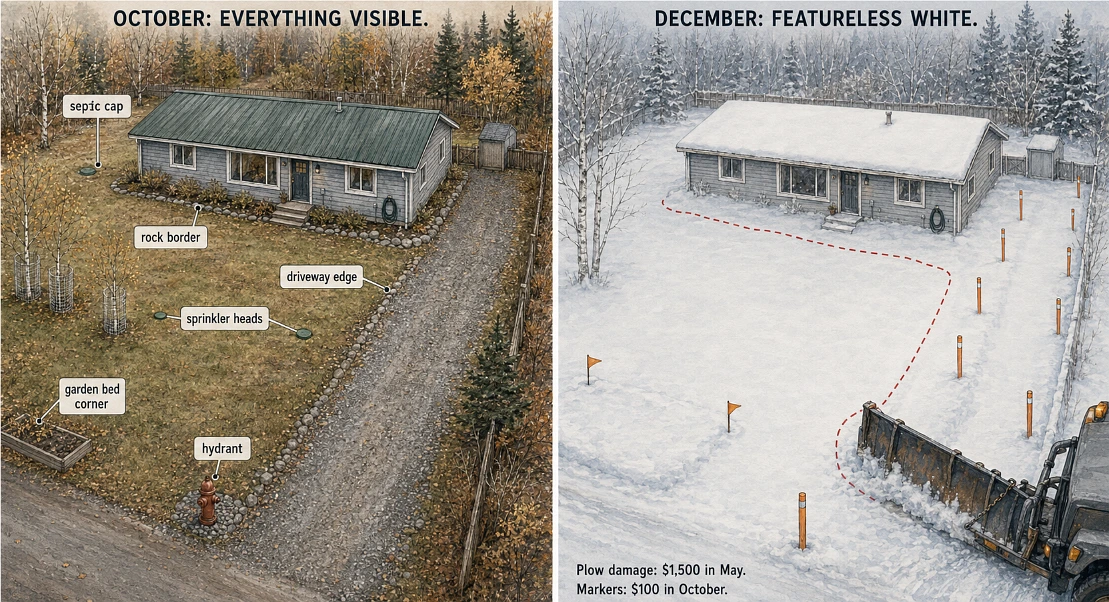
By December the entire property is a featureless white surface. Anyone plowing a driveway or running a snowblower has no visual reference for where the lawn edge is, where the buried sprinkler heads sit, where the rock garden border ends.
Snow plow damage to landscaping is the single most common spring repair call for South Central landscaping crews. The damage happens because the plow operator couldn’t see the edge of a flower bed or didn’t know there was a low juniper under what looked like a snowdrift.
Mark everything before the first lasting snowfall:
- Driveway edges with fiberglass driveway markers at least four feet tall, spaced every eight to ten feet
- Fire hydrants with a single tall marker so the fire department can find them
- Buried utilities, well caps, and septic access points with their own distinct markers
- Rock landscaping borders, raised garden bed corners, and anywhere a low feature sits below snowline
Wooden stakes don’t survive. They snap at the soil line when the snow weight settles. Fiberglass markers cost $3 to $6 each and last multiple seasons. Spending $100 on markers before October is cheaper than $1,500 in plow damage repair in May.
The Final Week Before Freeze
Foundation protection and water shut down
This is the part most homeowners think they don’t need to do and then regret in February.
Disconnect every exterior hose. Drain the spigot by opening it briefly after disconnection. If your home has frost free hose bibs, you’re done. If it has older standard spigots, locate the interior shutoff valve for that exterior line and close it, then open the spigot to drain the residual water that sits between the shutoff and the exterior wall.
A burst pipe in a Wasilla or Eagle River home during a minus 20 cold snap can flood a basement before anyone notices. Insurance claims for frozen pipe damage in South Central Alaska average $15,000 to $25,000 based on industry data, and many policies have explicit exclusions for damage caused by failure to winterize.
Foundation protection matters less in Alaska than people from the Lower 48 assume, because most homes here are built with engineered foundations rated for the climate. The issue is what’s stacked against the foundation. Move firewood, debris piles, and anything that traps snowmelt against the wall. When that snow melts in April, water pools against the foundation, freezes overnight, expands, and creates the hairline cracks that eventually become structural problems.
FAQs
The cutoff is the first hard freeze, which typically lands between September 26 and October 5 based on long term NWS averages for Anchorage. After the first night where temperatures drop below 28 degrees for more than four hours, the risk of having residual water freeze inside the backflow assembly increases significantly. Most reputable landscaping companies stop accepting new blowout appointments around October 10 to avoid liability for damage that occurs because the work happens too late.
Yes, but only the right kind. Standard nitrogen heavy lawn food applied in late September promotes top growth that won’t survive the freeze and weakens the plant going into dormancy. A potassium dominant winterizer blend applied immediately after core aeration in late September or early October sends nutrients to the root system specifically for winter hardiness, not blade growth.
Moose strip bark in vertical lines from approximately four feet up to eight feet high, leaving distinctive tooth scrapes that run with the grain of the wood. The damage is always above snow line. Snowshoe hares and voles cause damage below snow line, typically in the first eighteen inches of trunk, and the bite marks are much smaller and horizontal across the trunk rather than vertical.
For most mature trees, no. Established birch, spruce, and cottonwood handle Alaska winters without protection. Wrapping matters for trees under five years old, for non native ornamentals like ornamental fruit trees and Japanese maples, and for any tree that took transplant stress within the last two growing seasons. Mature spruce occasionally need protection from spring sun scald on the south facing trunk side, but this is the exception rather than the rule.
Winter prep in Alaska isn’t about doing more than property owners in Minnesota or Colorado do. It’s about doing it on a tighter calendar with consequences that don’t exist further south. Get the irrigation cleared, the lawn cut and cleared, the trees protected from snow load and moose, the lawn fertilised correctly for dormancy, the property markers installed before the first lasting snow, and the exterior water lines fully shut down. Miss any of those windows and the bill arrives in spring.
Special thanks to Alaska Landworks team for helping me write this article.
 Decor & Improvement Accessories